One World, Many Surfaces: The Art Direction of P.A.T.H.: Vietnam
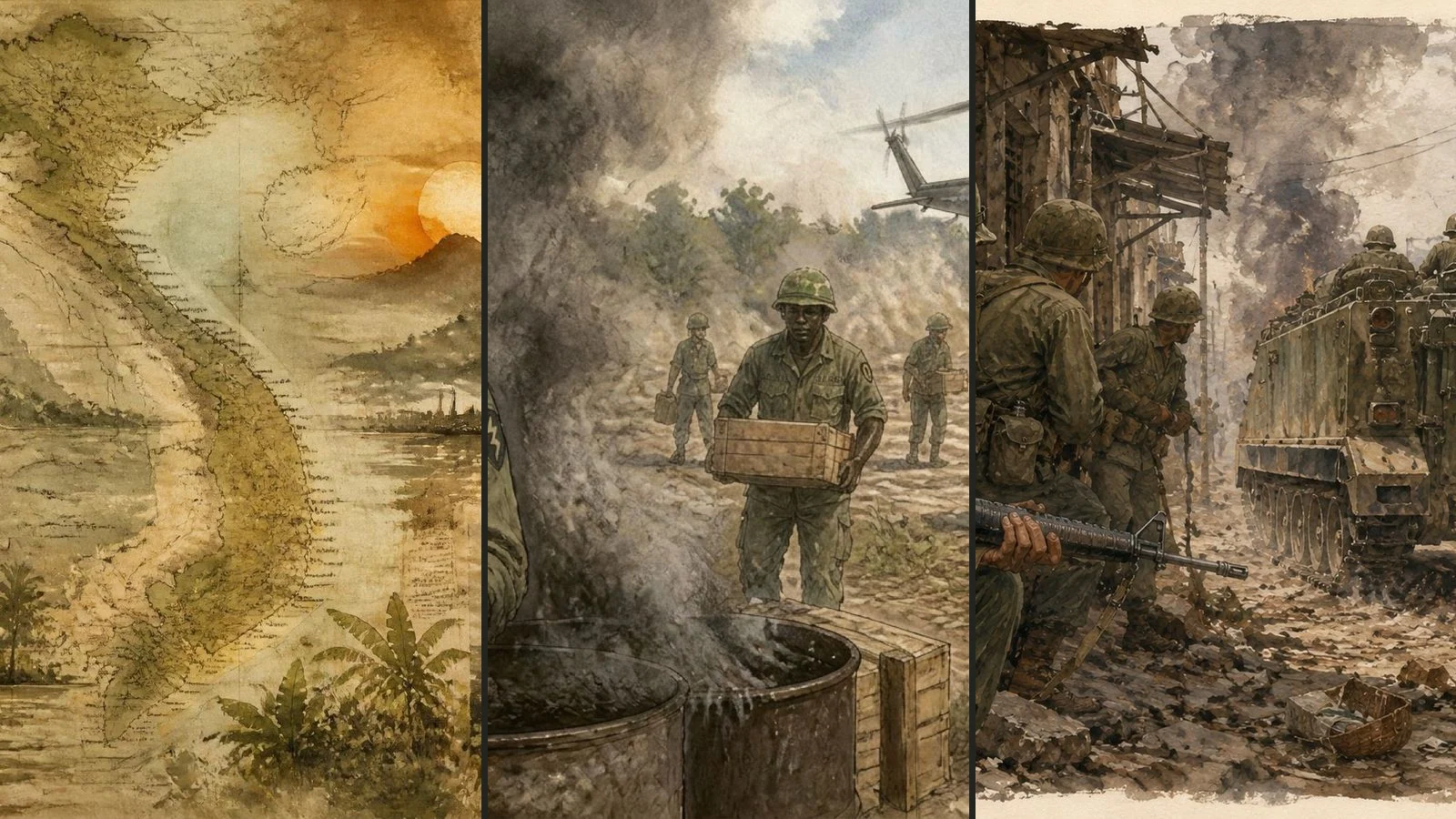
P.A.T.H.: Vietnam needs to show many different kinds of life. A quiet hometown, a crowded processing depot, a wet firebase, a field operation, a letter from home and a service record all belong to the same tour. They should not all look identical, but they cannot feel as though they wandered in from six unrelated games either.
That has become the central question behind the art direction: how can one visual language hold a whole year without flattening it?
The answer I keep returning to is a mixture of illustrated memory and physical evidence. The narrative scenes use loose ink, watercolor, worn colour and cinematic framing. The Field Desk uses paper, folders, stamped forms, ledgers, photographs and objects. One side is how a moment is remembered. The other is what the soldier can still put his hands on.
Together, they make the tour feel inhabited.
A painting should do more than fill the screen
The easiest use of game art is illustration: the text says “patrol,” so the screen shows soldiers on patrol. That is useful, but it is only the beginning.
The stronger images answer a second question. What does this moment feel like?
A work detail should have weight, heat and repetition. A radio scene should feel private even when the voices are travelling across a country. A hometown image needs enough warmth to explain why leaving matters, without turning home into a perfect postcard. A scene of danger should make the situation legible without treating suffering as spectacle.
This is why I prefer an illustrated, slightly weathered surface to a polished action-game finish. P.A.T.H.: Vietnam is not asking the player to admire a weapon render or race toward the next explosion. It is asking the player to remember who was present, what was carried, what was said and how much time was left.
The image has to leave room for that.
The desk speaks a different dialect
The Field Desk is not painted like an operation because it performs a different job. It is the place where the tour becomes paperwork and personal evidence.
The Service Record is dense because military records are dense. The calendar looks handled because the player returns to it repeatedly. The Pocket Guide is presented as a complete publication, not reduced to a decorative cover. Kit, PX goods and photographs appear as individual objects because their identity matters. A carton, a camera, a radio and a pair of dry socks do not mean the same thing simply because all four fit inside an inventory.
This paper-and-object language also slows the player down in a useful way. Opening a folder feels different from entering a combat scene. Turning a page feels different from choosing a field action. The interface quietly tells the player what kind of attention is required before a paragraph is read.
That is art direction too. It is not only the quality of a picture. It is the relationship between the picture, the words and the action the player is about to take.
The honest image is better than the exciting image
One of the less glamorous lessons has been that visual variety can become a mistake. The game contains hundreds of daily and historical moments. It is tempting to attach a dramatic image to every one of them simply to avoid repetition.
But an exciting wrong image is worse than a restrained fallback.
A report about casualties should not automatically show an active firefight. A mention of mail should not create a false mail-call scene. A village meeting should not borrow an unrelated combat plate because both happen outside the wire. The picture changes how the player interprets the words, whether I intend it or not.
The current game therefore uses reviewed visual families where the meaning is clear and a quieter base image where it is not. More moments will receive specific art over time, but semantic accuracy comes before sheer quantity. I would rather repeat a truthful atmosphere than manufacture a false memory.
Faces, roles and the problem of the generic soldier
The player creates one person, not an anonymous camera. That makes character art especially important.
Role scenes need to show the practical difference between a Medic, RTO, Grenadier, Machine Gunner, Engineer or rifleman. Portraits and identity variants need to respect the soldier created during LifeP.A.T.H. without pretending one image can represent every background perfectly. Equipment must be recognizable enough that the image supports the rules rather than contradicting them.
The work is not finished. Some scenes still lean on broad representations, and some event families need more careful coverage. That is not a reason to hide the process. It is a reason to keep reviewing art in context instead of judging one beautiful image at a time.
An image can be excellent on its own and still be wrong for the moment.
A visual world built at human scale
The best sign that the art direction is working is not that a player says, “That background is impressive.” It is that the player notices the muddy fatigues, the letter on the desk, the familiar radio, or the way a place looks different after several difficult weeks.
P.A.T.H.: Vietnam moves between war, routine, memory and administration. Its visual language has to make all four feel connected. The paintings carry the emotion. The documents carry the record. The objects carry the small decisions that make one soldier's tour different from another.
The goal is not a perfect museum surface or an endless gallery of dramatic scenes. It is a believable visual memory: incomplete in the way memory is incomplete, specific where the evidence is strong, and quiet enough for the player's own character to remain at the centre.