
PX, Quartermaster, Black Market: Three Ways to Get What You Need
There is more than one way to acquire something in P.A.T.H.: Vietnam, and the difference is not cosmetic.
The PX handles personal purchases. The Quartermaster issues Army property. The black market will eventually open a less official route, but only when the tour reaches the right beat. These systems can sometimes answer the same practical need, yet they work by different rules and on very different clocks.
The PX also has two distinct faces. There are the goods a soldier can buy at the base PX or PX truck today, and there is a much broader PX/PACEX catalogue whose orders take time to arrive. Treating those as the same instant shop would erase much of what makes them interesting.
The PX counter is about what is available now
The base PX and the smaller PX truck carry the things the Army does not issue: cold drinks, cigarettes, candy, magazines, toiletries, film and other ordinary comforts. Some items are useful. Some ease stress or improve morale. Some are simply personal in a place where most of a soldier's equipment looks exactly like everyone else's.
This is the immediate side of the PX. If an item is in stock and the soldier has the money, it can be bought without waiting for the mail. Stock still has a date and a place. A monthly magazine should not sit on the rack forever, and an issue that has not arrived yet should not appear early merely because its art already exists in the game.
That makes the shelves a small picture of the tour. Sometimes the useful thing is there. Sometimes the familiar brand, current magazine or minor luxury has not arrived. The choice is not only whether the soldier can afford something, but whether the present moment offers it.
The PX catalogue is the longer game
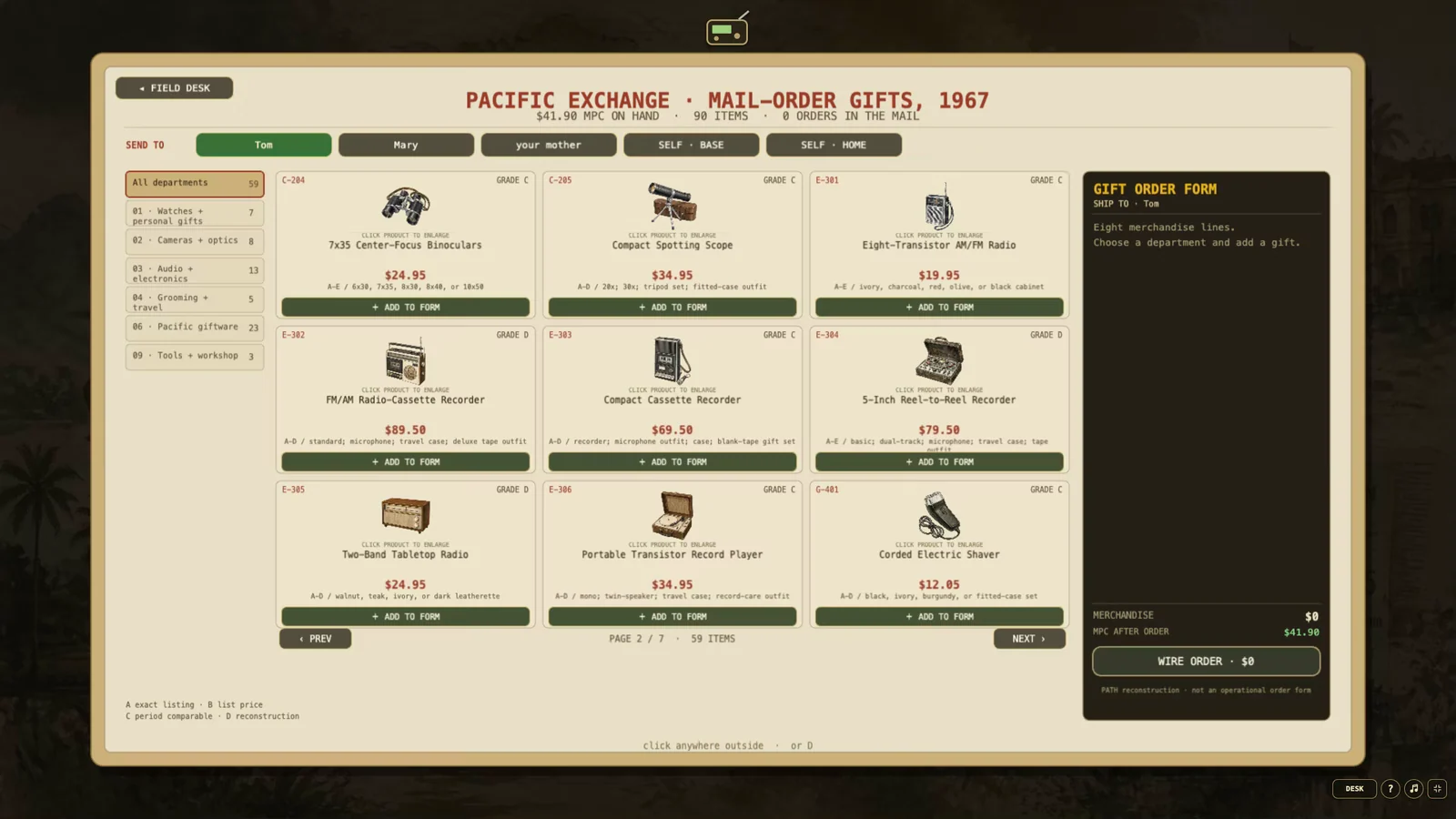
The broader PX/PACEX catalogue is not just a larger version of the counter. It opens a much wider field of goods: cameras, radios, recorders, watches, optical equipment, household items, gifts and other purchases that would never all fit inside a small base exchange.
The current reconstructed catalogue contains more than 90 items. That number is useful because it gives the player real variety, but the important feature is the delay. An order is placed and paid for now. The item enters the mail and arrives later. It does not instantly appear in the soldier's kit because a button was pressed.
Some catalogue choices are for the soldier. Others can be sent home or bought with somebody else in mind. A camera might change what he chooses to remember. A radio or recorder might change an evening in the hooch. A gift sent home can say something that a short letter does not. The same catalogue therefore supports equipment, leisure, memory and relationships without pretending that all purchases are interchangeable bonuses.
The delay creates anticipation and uncertainty. Will the package arrive before an operation, a birthday or DEROS? Is it worth tying up the money now? Does the soldier buy the modest thing on the shelf today or wait for the thing he actually wants? The catalogue turns shopping into a decision about time.
The Quartermaster does not sell anything
The Quartermaster is a supply system, not a shop.
Standard field gear, ammunition, replacement equipment, specialist tools and weapons belong to the Army. The soldier draws them, carries them and may have to return them. Ammunition and ordnance can move quickly. Ordinary gear may take time. Weapons and specialist equipment can require authorization, and some items are limited by role, rank, field experience or assignment.
That structure prevents the supply depot from becoming an all-purpose vending machine. A Medic can see medical stock because it belongs to the job. An RTO can draw signal equipment. A soldier can replace worn essentials or prepare for a difficult operation, but cannot casually collect every weapon on the shelf.
Where the item goes also matters. Extra ammunition rides on the soldier or returns to supply; it does not become a permanent footlocker collection. Heavy equipment creates a real load. A fresh item may solve a wear problem while creating an encumbrance problem.
The useful habit is to visit the Quartermaster with a purpose: replace what has failed, refill what was used and draw the role equipment the next job actually requires. Availability is not the same thing as wisdom.
The black market will open at the right beat
The black market is not meant to be an ordinary shop that sits open from the first day of the tour.
In the current build, this part of the economy is still represented through a limited fixer encounter. The intended next form is a proper, openable catalogue that becomes available only at the appropriate narrative beat. It will have its own items and options rather than borrowing the PX list or pretending to be another Quartermaster screen.
That distinction matters. The player should not arrive in-country already knowing every unofficial connection. Access has to emerge from the tour. When the catalogue becomes available, its timing should tell the player that a new door has opened and that using it is a choice.
The exact stock, exchanges and consequences still need to be finalized, so they should not be described as current features yet. The design direction is clearer: this will be a beat-gated catalogue with items and choices of its own, not merely a random trade prompt and not a permanently available fourth PX.
Three supply worlds, four different clocks
The three supply worlds overlap just enough to create meaningful decisions, but the PX world has two doors:
- The base PX or PX truck offers a smaller range that can be bought now.
- The broader PX/PACEX catalogue offers more choice, but delivery takes time.
- The Quartermaster issues approved Army property according to need and role.
- The future black-market catalogue opens only at the right beat and follows
its own rules.
A pair of replacement boots might come through Army supply. Candy, a current magazine or toiletries might be available immediately at the PX. A camera, recorder or gift might be ordered from the catalogue and arrive days later. An unofficial item or option may eventually appear through the black market only after that route has entered the soldier's story.
The object is only half the decision. The other half is how it was obtained, how long it took, what it cost and what the soldier had to carry afterward.
A practical starting approach
A new player does not need to master the whole economy on the first day. A simple routine is enough:
- Check the current load before acquiring anything heavy.
- Use the Quartermaster for issue gear, ammunition and replacements.
- Check the PX for immediate personal needs and small comforts.
- Browse the larger PX catalogue for items worth paying for and waiting for.
- Treat every catalogue order as a future event, not instant inventory.
- When the black-market catalogue eventually becomes available, judge its
items and options by the circumstances that opened it.
The point is not to own everything. The point is to notice why the soldier reached for one thing instead of another.
A clean weapon, dry socks and enough ammunition may keep him functioning. A radio, magazine, photograph or package from home may remind him why functioning matters. The supply systems make both kinds of need playable, while their different clocks keep acquisition tied to the life of the tour.