
Where Should P.A.T.H.: Vietnam Live?
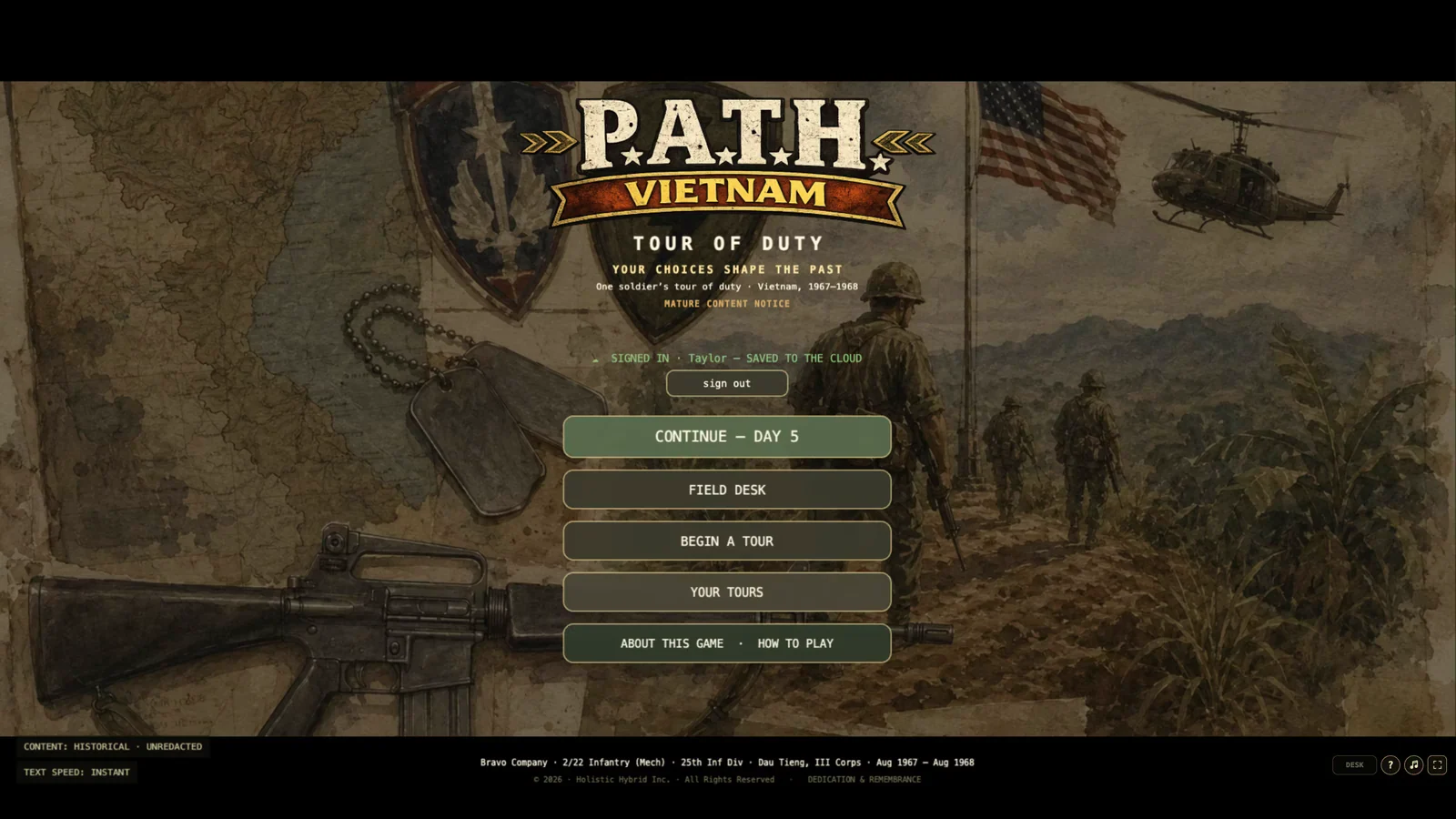
Should P.A.T.H.: Vietnam be a web game, an itch.io release, a Steam game, an iPad app, or some combination of those?
The honest answer is that I do not know yet.
That is not a lack of ambition. It is the result of the game becoming clearer. The release method should serve the experience I have built, not become the identity of the project before the evidence exists.
An earlier version of this dispatch asked whether P.A.T.H.: Vietnam could become a paid iPad game. It can. But “can” is a very low bar. It could also remain on the web, appear on itch.io, be packaged for Steam, or move through those places in stages. The better question is where players can comfortably begin a tour, trust their save, hear the radio properly, read the Field Desk, and return for hundreds of in-game days.
That is the release decision.
What exists today
The current game is browser-based. React holds the surrounding application; Phaser runs the cinematic game experience. The same build supports visible touch, mouse, and keyboard paths. The Field Desk, Pocket Guide, radio, journal, calendar, kit, safety controls, and daily tour all live inside that foundation.
There is no current native iOS project. There is no current Steam desktop package. There is no separate console build. Calling any of those “nearly finished” would confuse a working game with a distribution wrapper that has not been built and tested.
The browser is therefore more than one candidate storefront. It is the reference version from which the other choices begin.
The web is the shortest road
A web release asks the player to open a link and begin. There is no installation step, no store review, and no platform-specific package between a correction and the next build. That makes the web especially useful while the complete tour is still being tested and tuned.
It also preserves the game's broadest input range. A desktop player can use a mouse and shortcuts. A touch player can use the visible controls. A returning player can come back from another machine when the account and cloud path has been properly verified in the release environment.
The weaknesses are real. A long historical game can be difficult to discover as “a website.” Browser storage has limits. Offline behaviour is not automatic. Audio and artwork make the download substantial. Different browsers handle sound, full-screen behaviour, memory, and interrupted sessions differently. The game still needs a home page, support path, privacy truth, and a reason for someone to trust a link with a year-long story.
Web is the easiest place to keep building. It is not automatically the easiest place to build an audience or sell a complete campaign.
itch.io is a useful bridge
itch.io can give an independent game a recognizable project page without forcing the project to pretend it is already a conventional desktop title. A browser build can be presented there, and a downloadable package could follow later if one earns its way into the plan.
The attraction is flexibility. I could use it for a limited public build, a demo, a development release, or a paid version. The page can explain the pace and subject clearly. Players who already look for unusual narrative and historical games may be more willing to meet P.A.T.H.: Vietnam on its own terms.
The caution is that a storefront page does not solve the underlying release work. Saves still have to be reliable. The large audio and art footprint still has to load sensibly. The full tour still has to be playable. Packaging and hosting limits still have to be checked against the final build. A release on itch.io is a real release, not an excuse to call a test build finished.
For that reason, itch.io feels like the most natural bridge between private web testing and a wider audience—but only after the core player promises are ready.
Steam asks for a desktop game
Steam could put the project in front of players who already understand buying, installing, updating, and returning to a long-form PC game. The Field Desk, keyboard shortcuts, readable records, and slow campaign rhythm could fit that setting well.
But the current browser source does not become a Steam game by adding a store page. It needs a dependable desktop package. Window sizes, full-screen changes, audio devices, suspend and resume, local file locations, updates, cloud-save expectations, crash reporting, controller expectations, and a wide range of PC hardware all become part of the product.
Steam also changes the audience's comparison set. Players will not compare the game only with other experimental browser projects. They will compare its onboarding, settings, performance, store presentation, support, and finish with other paid games in their library.
That may be exactly the standard P.A.T.H.: Vietnam should eventually meet. It is still additional work, and the value of doing it should be supported by player interest rather than the prestige of having a Steam page.
Apple App Store - Google Play Options
The game can be wrapped for tablets/apps without rewriting every scene in native code. Its visible controls and landscape composition offer a credible starting point. The reading, artifact, desk, and touch interactions make the experience feel unusually personal on a tablet.
The word “wrapped” can make the job sound smaller than it is. An iPad release would need a real application project and repeated testing on real devices. It would have to survive interruptions, backgrounding, rotation policy, audio changes, memory pressure, updates, and account recovery. Every Field Desk page, choice, artifact page, and text-size setting would need to work comfortably by touch. Privacy, support, age rating, store review, and account-management rules would become release gates.
The music does not choose the storefront
The redesigned radio makes every release path stronger. Original songs, fictional bands, fictional DJs, announcements, PSAs, and PATH-remixed programme formats avoid building the experience around a library of famous commercial recordings.
That was a creative and practical decision, not an iPad requirement. Copyright does not become less important on the web or itch.io, and it does not become more artistic because a store has a review process. Each release still needs a final rights ledger and listening approval for the exact files it contains.
The same is true of the recreated Pocket Guide, historical writing, artwork, and every other artifact. A feature being present in source proves that it is implemented. It does not automatically prove historical accuracy, production deployment, owner approval, or release rights.
What should decide the path
I want the choice to come from evidence that a player can feel:
- Can a new player understand the opening and make a soldier without help?
- Can the full tour be completed without the save becoming fragile?
- Does the Field Desk remain readable and reachable across realistic screens?
- Does the radio start, continue, pause, seek, and resume without becoming a burden on loading or storage?
- Do the motion, flashing, content, text, and decision-pressure controls work throughout the experience rather than only in a settings test?
- Where do the people who genuinely want this kind of game prefer to play?
- Do they want a link, a downloadable independent build, a Steam library entry, or a tablet experience?
- What price, if any, matches the finished campaign and the support I can realistically provide as a solo developer?
The last point matters. A release creates maintenance, communication, refunds, account questions, bug reports, and expectations. The largest storefront is not automatically the best first home for a quiet solo project.
The path I took so far
Today, the browser build is the source of truth and I'm using it to finish the player journey. I'm working to improve the opening, character creation, first week, Field Desk, operations, saving, radio, and ending in that build before splitting attention across other release packages.
Eventually, I will take deliberately small steps.
First, run a controlled web playtest with people who have not watched the game grow. Measure whether they return, where they stop, what they misunderstand, and whether the game keeps their tour safely. That evidence is more useful than asking friends which platform logo they recognize.
Second, prepare one distribution experiment rather than three. itch.io is the most natural first candidate because it can remain close to the web build while giving the project a recognizable independent-game home. If the strongest interest comes from PC players who want an installed premium campaign, the next proof should be a desktop package for Steam. If players consistently want the desk and artifacts in their hands, the next proof should be a tablet build.
None of those experiments needs to become a promise before the full concept works.
A release is another path
P.A.T.H.: Vietnam asks what one person carries into a tour, through it, and home. The release decision deserves the same care. Each platform adds something and asks for something in return.
Web offers reach and speed. itch.io offers an independent-game doorway. Steam offers a familiar home for a long PC(Mac) campaign. iPad/Tablets offers a close, tactile way to hold the Field Desk. A staged combination may eventually be better than any single answer.
For now, I am going to finish and test the game as a web release.
Then I can choose the path to evolve the game once I have a more refine working model.