
Journal and Tour Log: Two Records of the Same Day
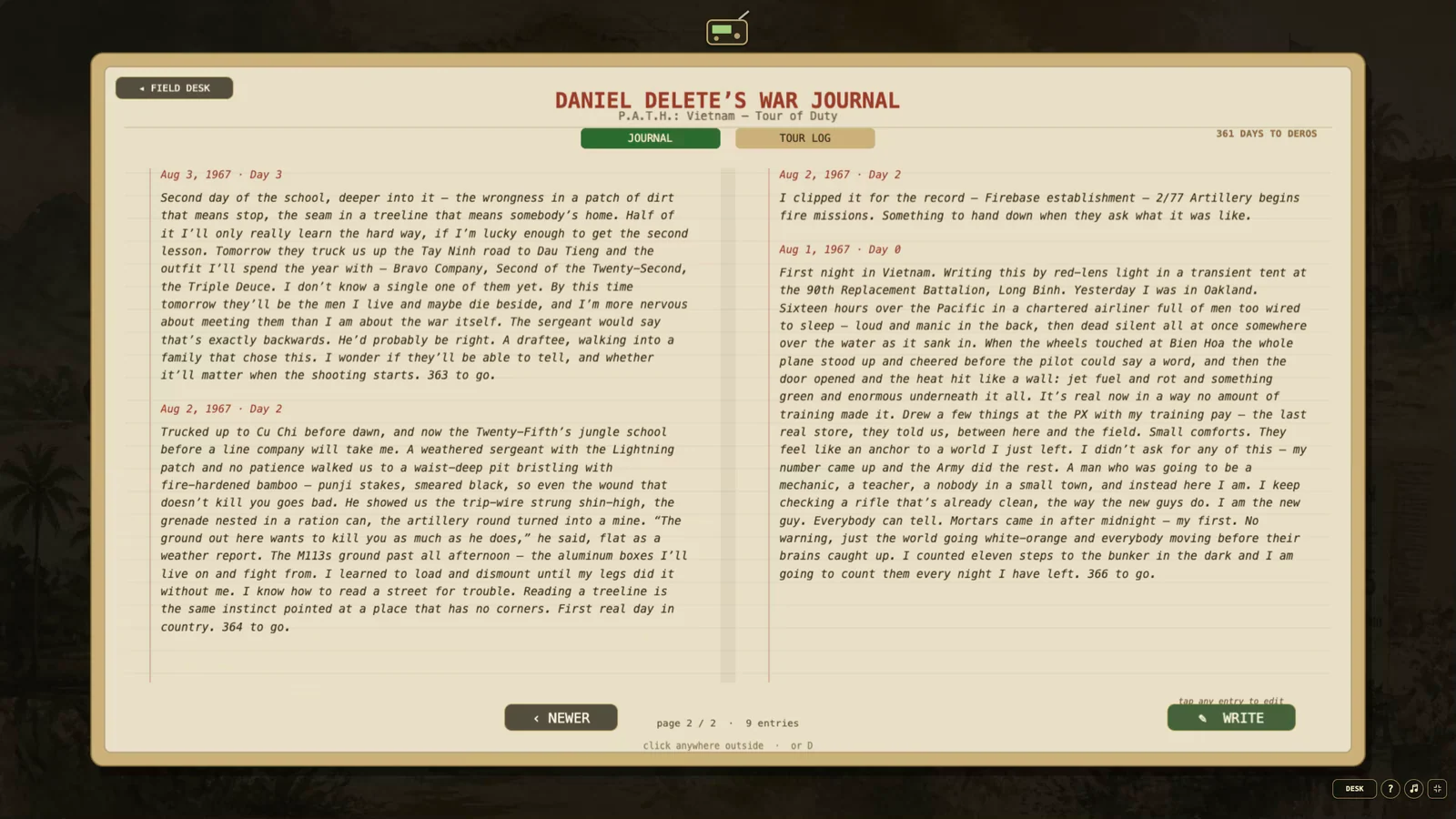
P.A.T.H.: Vietnam keeps two closely related records: the Journal and the Tour Log.
They are not duplicates. One helps the day become memory. The other helps the player find what happened.
That distinction matters in a game that covers a complete tour. After dozens of days, even important moments can blur. After hundreds, a single stream of prose becomes difficult to navigate. The game needs both the shape of memory and a practical way to inspect recent activity.
The Journal tells the day
At the end of Night, the game gathers what happened into a journal entry. The morning event, duties, small actions, relationships, upkeep, photographs, money, and consequences can all leave traces.
The entry does not claim to be a perfect literary account. Its job is continuity. It prevents one day from vanishing when the next Dawn arrives.
This is especially important for quiet days. A major historical event will be easy to remember. The evening when a squadmate first trusted the character, the day he finally wrote home, or the night he chose sleep over another task may not announce itself as a milestone. The journal allows importance to emerge later.
Reading several entries together can reveal a pattern the player did not notice while making individual choices. The character may be writing less, resting poorly, spending more time with one person, or treating every quiet shift as preparation. The story appears in repetition.
Your private line
The automatic journal knows what happened in the system. It does not know exactly what the event meant to you.
That is where a private entry helps. The player can add a thought, a sentence, or a small correction. It does not need to become creative-writing homework.
Useful private notes are often short:
- “He said he was fine. I did not believe him.”
- “Sent the watch home. Did not explain why.”
- “First day I stopped counting before breakfast.”
- “Carried too much again.”
These lines give the player ownership without requiring the game to predict every emotional response. They also create a record no automated system could produce honestly.
You do not need to write every night. Use the feature when the official description and your understanding of the character are not quite the same.
Tour LogThe Tour Log finds the facts
The Tour Log is more structured. It records a bounded recent trace of important beats, choices, milestones, economic activity, photographs, relationships, and day changes in a form the player can revisit.
Think of it as the index behind the diary.
If you want to remember when a photograph was taken, when a financial choice was made, or which day carried a particular event, the Tour Log is easier to search mentally than a long run of prose. Categories help separate different kinds of memory.
It is important not to oversell this screen. The Tour Log is not an unlimited, permanent archive of every action taken across all 366 days. It keeps a useful recent window and may be trimmed further if local browser storage is under pressure. Longer-lived campaign meaning is also carried in the Journal, historical clippings, decision flags, relationships, and narrative memory—not in one magic ledger that can never run out of space.
The player does not need to inspect this machinery constantly. It is there when recent memory needs a little evidence.
Official record, private record, structured record
The Service Record, Journal, and Tour Log form a useful triangle.
The Service Record shows what the institution can classify: training, rank, decorations, condition, load, and service facts.
The Journal shows what the day felt like when its pieces were gathered.
The Tour Log shows the recent structured sequence of choices and events.
No one view is complete. A decoration may appear on the Service Record after paperwork and ceremony. The Journal may remember fear or confusion from the same event. The recent Tour Log may still show the decision that led there—or, much later, that detail may survive somewhere else in the campaign's records. The differences are not inconsistencies. They are perspectives with different purposes and limits.
This is one of the game's central ideas: history is made from records, but a person is never fully contained by one record.
How often should you read?
A good rhythm depends on the player.
If you enjoy daily reflection, read the Journal each night. It becomes the closing ritual of the four-shift loop.
If you prefer a faster pace, check every few days or after an operation. The accumulated entries can create a stronger sense of change.
Use the Tour Log when looking for a specific fact, reviewing a relationship arc, or returning to a saved campaign after time away.
Before training a skill, read recent entries. The record may reveal what the character has actually been learning. Before sending an important gift or making a large financial choice, revisit the correspondence and decisions that gave it meaning. Near a major calendar threshold, look back at the first week.
The game covers enough time for the player to become his own historian.
Memory without completionism
Do not try to produce the perfect journal.
Some entries will be vivid. Some will be repetitive because life is repetitive. Some days will deserve a private paragraph; others deserve nothing more than the automatic line. The unevenness makes the record more believable.
The same applies to the Tour Log. It is not a checklist that must contain every possible category. One character may take many photographs. Another may leave that section thin and build a dense trail of correspondence or squad relationships.
Absence can also say something.
The final value
At the end of the tour, the player does not receive only a result. He has a history.
The Journal gives that history voice. The Tour Log gives it structure. The Service Record gives it an official face. Together they allow the player to ask not merely, “Did I make it?” but “How did I live the days that got me here?”
That question is why the game writes things down.