
What Your Pay Says About You
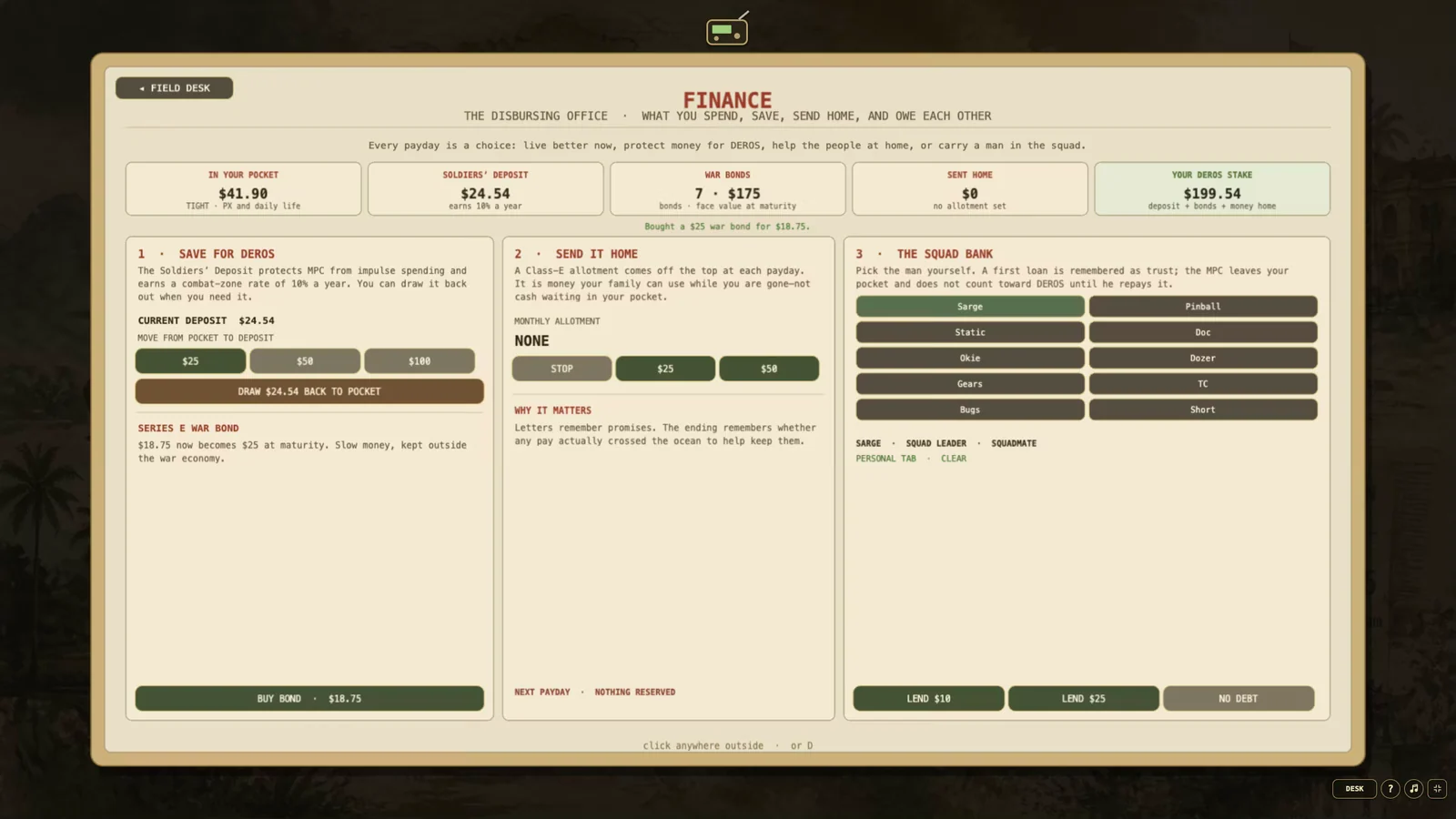
The Finance desk in P.A.T.H.: Vietnam does not exist to turn the tour into a business simulation. It exists because money connects the soldier to three different lives at once.
There is the person in-country who wants comfort, equipment, and a little control. There is the life at home that may need support or still shape the character's plans. There is the squad, where a small loan can be practical, generous, awkward, or all three.
Pay becomes character because it cannot satisfy every claim.
Pocket money: the immediate life
Money held in pocket can be spent at the PX or used for available personal needs. It creates flexibility. A truck may arrive with something useful. A small comfort may matter after a difficult stretch. Film, batteries, reading, clothing, toiletries, or a durable item can change what the character is able to do.
Keeping cash available is therefore not automatically selfish. It can be preparation.
Spending it is not automatically wasteful either. P.A.T.H.: Vietnam treats comfort as part of endurance. A soldier is not a machine whose only valid purchase is more efficiency.
The question is whether the purchase fits the person and the moment.
Savings: the future imagined
Savings point toward a later life. The Finance desk applies a period-appropriate return to money intentionally set aside, but the emotional function is more important than the rate.
Saving says that the character believes there will be a future in which this money matters.
That belief can be strong at the beginning, shaken in the middle, and fiercely protected near the end. A post-war dream gives it form: school, a trade, a home, a business, travel, family, or simply room to decide.
A player does not need to maximize savings to prove the character has hope. Even a modest regular amount can become a ritual. The pattern matters more than a perfect total.
Money sent home: responsibility at a distance
An allotment or transfer home is different from saving. The money leaves the character's immediate control and enters another relationship.
For one soldier, this may be an obligation. For another, pride. It may support parents, a partner, children, or a shared plan. It can also create tension if the player wants to spend on the tour but the character's life says the money belongs elsewhere.
LifeP.A.T.H. makes this decision stronger by giving home a face before payday. Without that foundation, sending money is merely moving a number between columns. With it, the action can say, “I am still part of that household even from here.”
The Catalogue offers another way to reach home. Money and gifts are not identical. One supports. The other speaks through an object.
The squad bank: trust without paperwork
The Finance desk also allows personal loans to squadmates.
This is deliberately small-scale. A soldier may need a little money before the next payday. You can lend a fixed amount and track what is owed. The squad remembers the gesture.
That does not turn generosity into a guaranteed investment. Informal debt inside a dangerous year carries uncertainty. Repayment may arrive, may take time, or may become emotionally complicated.
The player should not approach the squad bank as a way to farm trust. Lend when it makes sense for the character and when losing access to the money would not destroy the rest of the plan.
The feature can also reveal boundaries. A caring character may still refuse. A frugal character may surprise himself. Someone who lends constantly may be generous, eager to be liked, careless, or simply better paid than the people around him.
Payday as a monthly checkpoint
Payday creates a useful planning moment. Instead of making financial decisions every shift, pause when new pay arrives and divide it intentionally.
A simple approach uses four envelopes:
- Keep: immediate pocket reserve.
- Save: money for the post-war future.
- Home: regular support or a planned gift.
- Share: room for squad needs and occasional generosity.
The percentages can change. There is no correct budget. The method simply forces the player to recognize competing priorities.
Review the character's condition and the PX before locking everything away. Check whether a catalogue order is already in mind. Look at outstanding squad loans. Then make the division once and return to the day.
Rank and time can change the plan
Pay and rank evolve through the tour. So does the player's relationship with money.
Early purchases may establish the character's field life. Mid-tour spending may be shaped by fatigue, loss, or stronger squad bonds. Late-tour decisions may lean toward home and the future because DEROS no longer feels theoretical.
The calendar makes this evolution visible. A gift sent with three hundred days remaining says something different from one sent with thirty.
The journal can help the player notice the change. Financial choices do not need their own dramatic entries every time, but a first allotment, a meaningful purchase, a loan, or a final catalogue order may deserve a private line.
Avoid turning money into a morality score
P.A.T.H.: Vietnam does not claim that saving is virtuous, spending is shallow, or sending money home is always the right answer.
A character may need comfort to remain functional. A family may need support. A soldier may save because hope matters or spend because tomorrow does not feel guaranteed. He may lend out of loyalty or refuse because previous debts have taught him caution.
The game supplies constraints and consequences. The player supplies motive.
By the end of the tour, the Finance desk can tell a quiet story. It shows what the character kept close, what he set aside, what he sent away, and what he risked on the people beside him.
Money does not define the soldier. Repeated choices about it reveal where he believed his life was located: here, home, later, or somewhere among all three.