
The Soldier You're Becoming: EP and Advancement
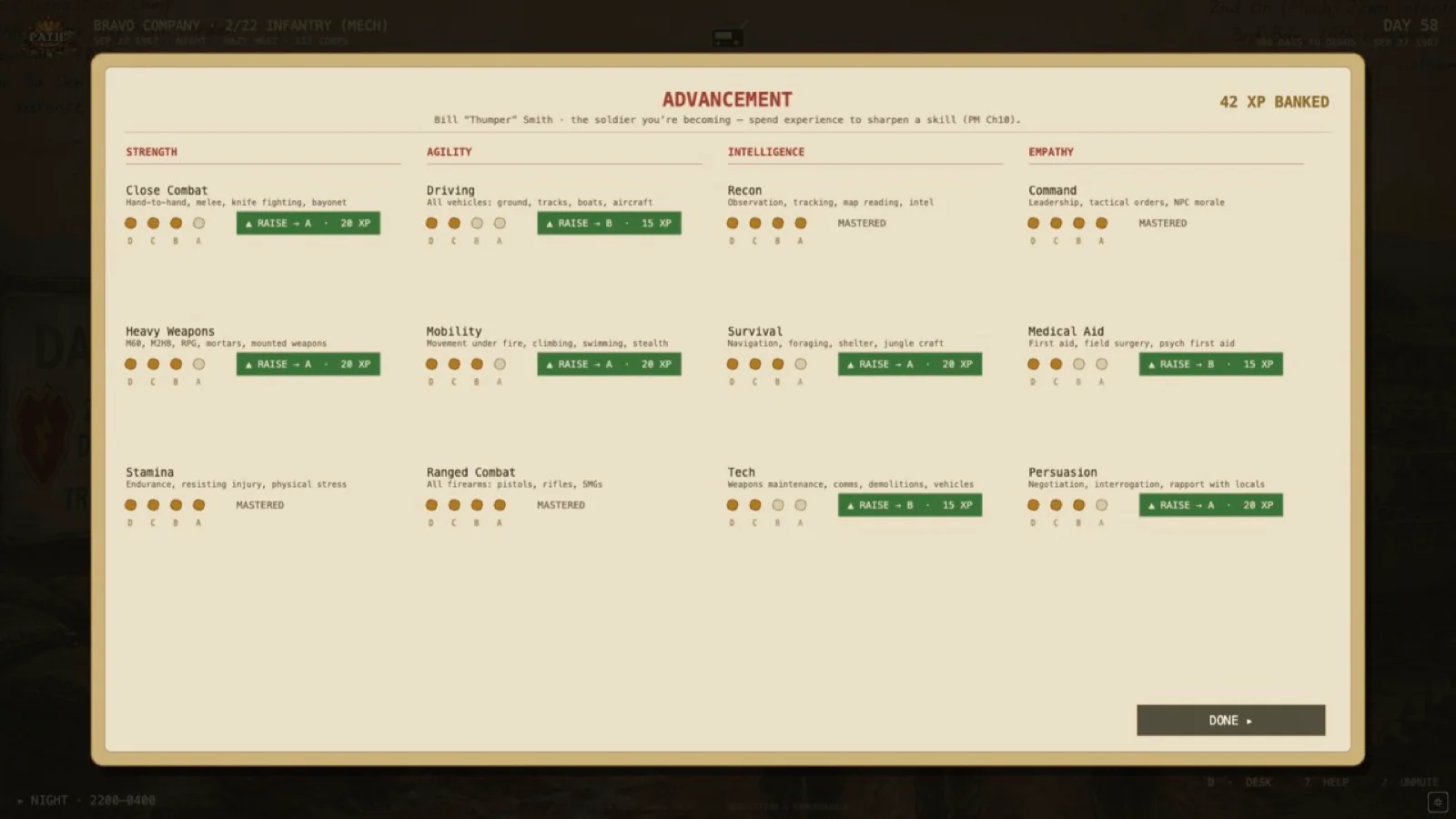
I have been working on advancement, and the question that keeps me occupied is quite simple: what has this person actually learned? A year is long enough for someone to change. It is also long enough for a generous reward system to turn everybody into an expert at everything if I am not paying attention.
I want the record at the end of the tour to look like it belongs to the person who lived it. If you spent months maintaining vehicles, helping a medic and trying to keep a squad together, those experiences should leave different traces. Surviving Tuesday should not somehow teach you everything required to repair an engine on Wednesday.
This is where the advancement work in P.A.T.H.: Vietnam (Pivotal Actions Through History) gets interesting for me. It connects the decisions made during a day to the person who will make the next ones.
Start with the work
I have tried treating the passing of a day too much like the end of a tabletop session. Hand out a little experience, carry on, repeat. Across a whole tour, that adds up very quickly. It rewards attendance more reliably than it records learning.
The better question is what happened during that time. Was there relevant practice? Was somebody teaching? Did the character take on a difficult part of a job, or simply happen to be nearby when it was completed? Those are details I want the record to preserve.
I am also wary of making danger the only useful teacher. Quiet practice has a place. So does supervised work. A person should not need to manufacture a crisis just to make progress on their character sheet. If I make the sensible decision mechanically pointless, I should not be surprised when players stop making it.
The experience record needs to explain where improvement came from. I want to be able to look back and recognise the work, rather than see an impressive total with no memory attached.
Having enough points is not the whole story
There is another trap here. Once points exist, they can start behaving like money: save enough, open a menu, buy whatever expertise catches your eye.
I want training to need a reason. A character might have a record of relevant field work, access to instruction or a suitable course. Time and opportunity matter. The fact that an improvement would be convenient does not create a teacher, a workshop or a piece of equipment out of thin air.
That should not feel like an arbitrary locked door. If something is unavailable, the game needs to explain what is missing. There is a considerable difference between being told no and understanding what you could do next.
I would like the player to make plans from that information. Find a person who can teach. Take a useful duty. Notice an opportunity while there is time to use it. Growth becomes part of the tour instead of something that happens in a separate shopping screen.
Make the record readable
The board on the Field Desk is where I want this to become understandable. What can the soldier do now? What has he been practising? What would the next step require? Those are the questions the page needs to answer before I start decorating it.
I am keeping the same paper-and-record language as the Service Record. Advancement belongs to the person whose letters, photographs and kit are on that desk. I do not want an unrelated arcade panel to appear every time there is a possibility of learning something.
Clear explanations matter more to me than a satisfying row of highlighted buttons. If the player has to guess why an option is available, I have left the important part of the design hidden. If the page suggests everyone can eventually do everything, I have probably made the shape of the character too easy to erase.
I want room to leave a decision alone, too. An available improvement is not an order to take it immediately. Sometimes the next useful step becomes clearer after another day of work.
Better at a job, still a person
Improvement should help. I am not interested in a system that records months of effort and refuses to let any of it matter. But growing more capable cannot make the circumstances disappear.
Equipment can still be missing. A route can still be dangerous. Another person can still know something you do not. Being very good at your part of a task does not turn the rest of the squad into scenery.
The differences between characters are part of the pleasure here. A medic becoming steadier at explaining a difficult situation is one story. A radio operator getting better at moving quietly with a patrol is another. A mechanic learning to be patient with people instead of only machines might be a third.
I want those changes to be understandable from the play. LifeP.A.T.H.—Previous Activities, Training, History gives the character a history before the tour; the work during the tour adds to it. The record should not forget the earlier person simply because the new one has improved.
The questions I am using
When I look at an advancement option, I ask three things: has the character done work connected to it, is there a believable way to learn it, and will the player understand the result?
That gives me a useful way to find mistakes. A reward that appears for unrelated activity needs another look. So does a training requirement that cannot be explained. And if the only attractive choice is always the most expensive one, I need to ask what I have made the other choices for.
There is still balancing and interface work in this. I am documenting the direction because it helps me keep the purpose in view while the details change. I want a tour that teaches a person something, and a record that can tell me what it was. That seems worth spending some time on.