Create a Person, Not a Superhero
I have spent a fair amount of time looking at character screens and asking myself whether I have made a person or just a very efficient collection of advantages. The numbers are useful. I also want to know who is going to write this person a letter, and why it might sit unopened for a day.
Character creation often begins with a familiar question: what is the strongest build?
P.A.T.H.: Vietnam (Pivotal Actions Through History) asks a different one: who is this person?
That is not a rule against planning. Your starting role, attributes, skills, specialty, and gear matter. A strong character is useful, and a well-matched specialty can change what you are able to do. But the game is a full tour rather than a sequence of isolated challenges. The character who looks perfect on one screen may feel thin after a hundred days if there is nothing behind the numbers.
The best way to begin is to make a person you are willing to follow for a year.
Start with a sentence
Before adjusting anything, try describing the character in one plain sentence.
Maybe he is a careful small-town mechanic who joined before he knew what the commitment would mean. Maybe he is a city kid who reads people quickly but does not trust institutions. Maybe he is a thoughtful medic who can handle a crisis better than an ordinary conversation. Maybe he is a strong, dependable Grunt who writes home more often than anyone expects.
This sentence is not a formal game mechanic. It is a compass. When two options look equally attractive, it helps you choose the one that belongs to this person.
It also prevents a common problem: treating every background detail as a way to squeeze out another advantage. P.A.T.H.: Vietnam connects background to real capability, but the connection is there to make the character coherent. Home, schooling, family, work, and social experience can shape what a person knows before training begins. They can also open story moments that another character would not see.
Understand what this person brings
I think about physical capacity, coordination, practical understanding and dealing with people. None of those is a universal answer to every problem.
In the revised Lucky 8 rules, PHYS describes physical work, FIELD describes working in the terrain, TAC describes reading and communicating a situation, and COH describes working with other people and holding yourself together. I want those broad capacities to help describe an action without becoming a complete personality test.
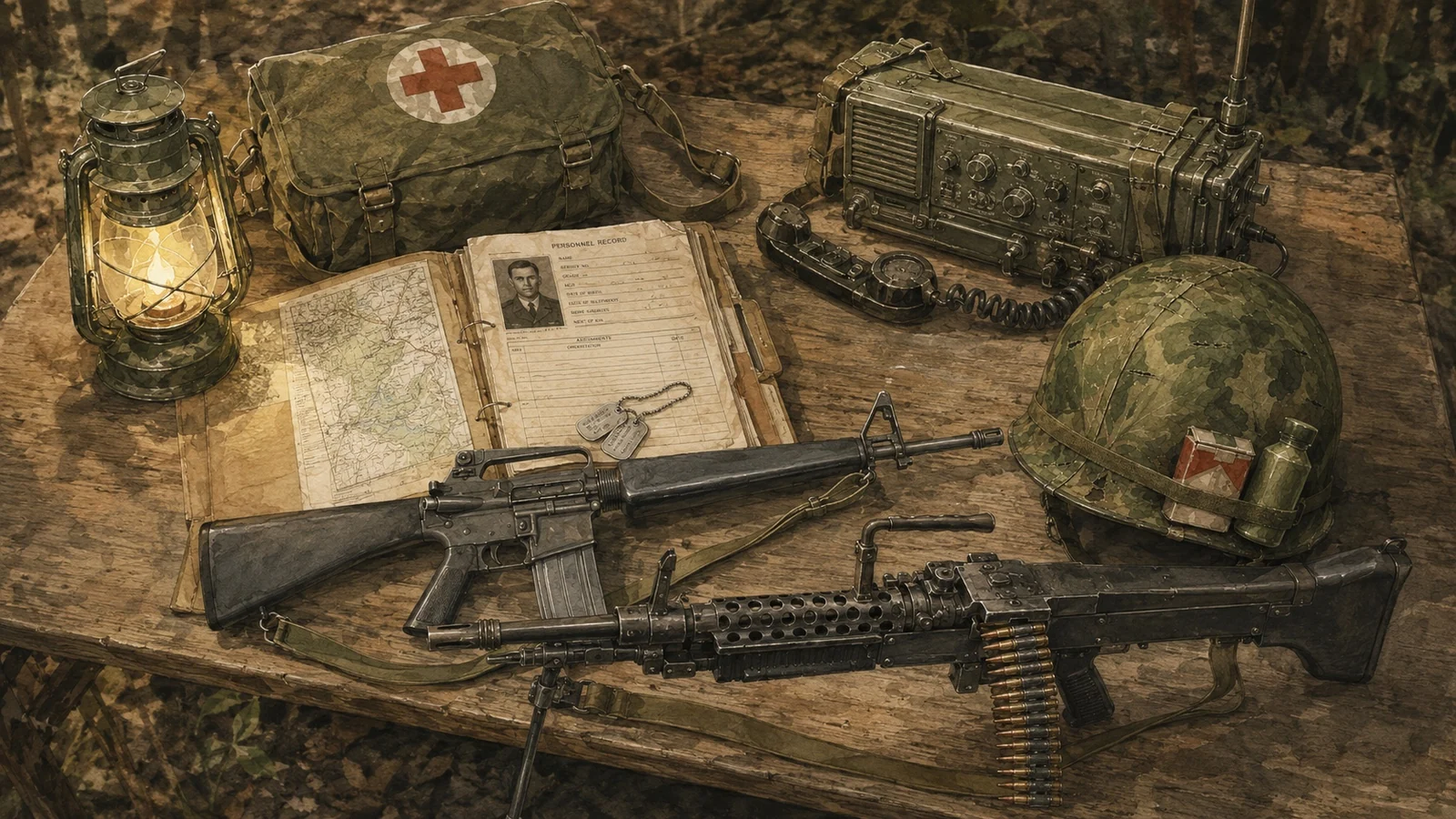
Your role establishes a sensible starting shape. A Machine Gunner is built to carry and operate a demanding weapon. A Medic needs medical training and the ability to work with people. An Engineer needs technical judgment as well as physical steadiness. The game is not asking you to turn every role into the same all-purpose hero.
Responding under pressure has its own consequences in the rules. I do not turn FUBAR into a standing penalty on every roll. A character can be capable, trained or socially confident and still need help when danger stops being theoretical.
Skills show what training looks like
I want the record to show what someone has learned and practised. The important thing at the start is not to master everything. It is to understand what this character has been prepared to do, and where somebody else may be better placed to help.
Your military role gives you a foundation. A Grunt begins with stronger ranged-combat ability. A Mechanic is comfortable with machines and driving. An RTO works around communication, observation, and the needs of command. A Forward Observer must read terrain and communicate accurately. These are not costumes placed on one generic character; they produce different daily problems and different kinds of usefulness.
Skills can improve during the tour. I want that growth tied to relevant practice and instruction, with time to learn instead of an instant purchase of expertise. Training is gradual. A weak starting skill is not necessarily a permanent failure; it may become part of the character's field education.
Choose an Archetype you want to play
Within those jobs, I want room for different duties and further training. Point work, medical responsibilities, demolitions and tunnel work ask different things of a person. A duty title does not grant a Qualification: the relevant course and evaluation still have to be on the record.
The tempting choice is the one that appears strongest on paper. A better question is: which situations do you want this character to recognize as his responsibility?
A Point Man does not merely receive a bonus. He takes the front of the problem. A Trauma Care specialist is choosing the moments when seconds and preparation matter. A Signals-focused RTO is saying that connection itself is part of his job. The specialty becomes more satisfying when you accept its burden as well as its benefit.
Give your Soldier a contradiction
Real people are rarely optimized around one idea. A useful fictional character should not be either.
Try giving your soldier one contradiction. The physically strongest man may be gentle with frightened people. The Medic may hate being depended upon. The Mechanic may understand engines but be careless with his own body. The RTO may carry everyone else's messages while struggling to write home.
The game will not always label these contradictions for you. They become part of how you read choices. That is valuable because P.A.T.H.: Vietnam leaves room for the player's imagination rather than insisting that every trait live in a drop-down menu.
Think about the future
LifeP.A.T.H.—Previous Activities, Training, History includes the life before Vietnam, but a good starting character also has a life pointed beyond it. What does he think he will do after the Army? Who expects him home? What object would matter enough to keep dry? What does he imagine the Freedom Bird will solve?
You do not need to write a novel. One relationship, one ambition, and one worry are enough. They give mail, money, photographs, and the catalogue emotional weight later.
There is no perfect start
A character can be effective without being complete. In fact, incompleteness is part of the point. The tour will add skills, scars, friendships, records, and memories. The person who leaves Dau Tieng should not be identical to the one who arrived.
So choose a role that interests you. Respect what its equipment weighs. Think about further training and duties that create situations you want to face. Let the background provide both capability and texture. Leave one weakness you are curious about.
Then begin.
The strongest P.A.T.H.: Vietnam character is not the one who wins every roll. It is the one whose choices still make sense after the easy answers are gone.