Ninety Small Objects: Making the Tour Tangible
An inventory can be accurate and still feel lifeless.
The game can say “camera,” “magazine,” “radio” or “M16 magazines” in a list and the rules will work. Weight can be counted. Money can be deducted. A morale effect can be applied. Nothing is technically missing.
But the player is still moving labels between boxes.
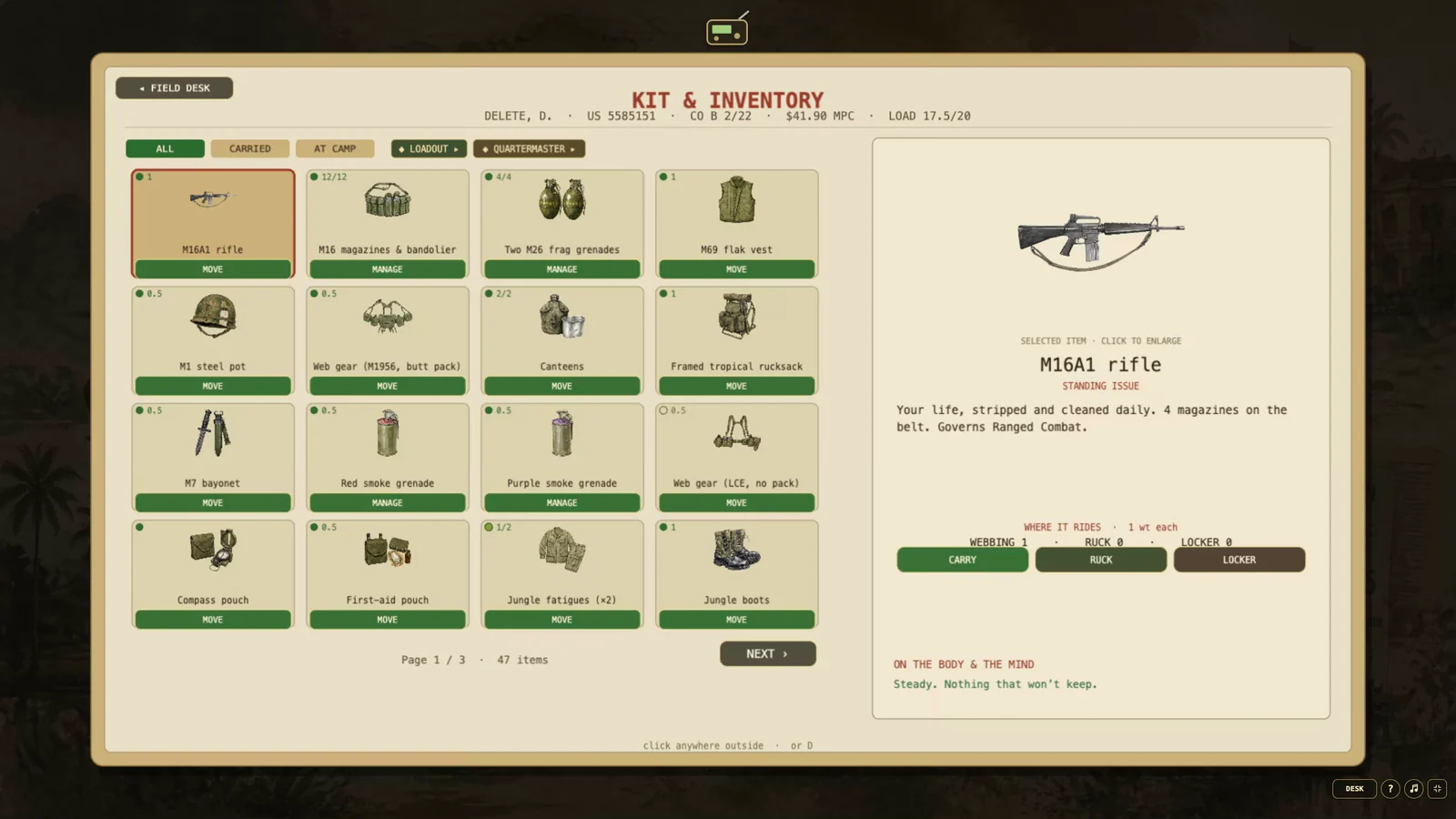
P.A.T.H.: Vietnam has moved in a more visual direction. The main PX now has more than 90 illustrated goods. The 1967 mail-order catalogue contains 90 distinct products with their own plates. The kit library has roughly 90 images covering weapons, ammunition, clothing, web gear, medical supplies, signal equipment, tools, rations and ordinary field necessities.
The numbers are substantial, but quantity is not the real achievement. The important change is that objects can now carry identity.
The PX should look stocked, not generated
A convincing PX needs more than one soda, one magazine and one generic box marked CANDY.
The shelves include cold drinks, several fictional beer labels, cigarette packs and cartons, snacks, chocolate, assorted candy, coffee, peanut butter, hot sauce, soap, shampoo, razors, foot powder, toothpaste, clothing, cards, paperbacks, cameras, film, radios, recorders, watches and other small comforts.
Some goods are useful because they address hygiene, stress or morale. Others matter because they create a preference. The soldier who buys a cheap field watch is making a different choice from the soldier saving for a camera. The one who brings candy back to the tent line may be remembered differently from the one who spends every MPC certificate on himself.
The art makes those choices readable at a glance. A can has a label. A carton has a shape. A radio looks like something that could sit on a footlocker. The PX stops feeling like a spreadsheet and starts feeling like a place where a young soldier might linger longer than necessary.
Dated magazines make the shelf part of the calendar
The reading rack has become one of my favourite examples of small detail doing large work.
The fictional BACHELOR and HOUR magazines have monthly issues rather than one cover repeated for the entire year. Other dated publications can arrive on their own schedule. The rack therefore belongs to the current month.
That sounds like a minor correction until the alternative is considered. A December cover appearing in August tells the player that the objects are decorations detached from the tour. A new issue appearing when the month turns quietly confirms that time is moving everywhere, not only in the calendar counter.
Magazine covers also create room for period design that is fictional rather than copied. Typography, headlines, colour and cover composition can evoke a 1960s rack without turning a real publication or personality into an unlicensed game asset.
The same principle applies to beer, tobacco and other branded-looking goods. The current families use fictional or generic identities. Names such as Beerwiser, Black Bear, Blue Rabbit, Copper City, Bière 88 Export and Rivière d'Or give the shelf personality while keeping the project out of somebody else's advertising archive.
Kit art has to support the rules
PX art can be playful. Kit art has a stricter job.
The player needs to distinguish a weapon from its ammunition, a carried item from a stored one, standard gear from specialist equipment and useful load from dead weight. A Medic's bag, an RTO's radio, an Engineer's tools and a Machine Gunner's belts should not collapse into one olive-drab icon.
The item plate is connected to a stable identity used by the rest of the game. That identity determines the name, description, weight, location and effect. Changing a picture cannot silently turn one item into another. Older saves also need to recognize replacements when a product or filename is revised.
This is the unglamorous part of visual richness. Every image has to be wired to the right object. A beautiful illustration with the wrong identifier is not content; it is a future bug.
Ninety products do not mean ninety meaningful choices at once
Large catalogues can overwhelm a player if the interface treats every item as equally urgent.
The game separates objects by place and purpose. The PX has aisles. The mail- order catalogue has departments and recipients. The Quartermaster has supply categories and authorization rules. Kit shows what is carried, worn, packed or stored. Details can be enlarged when the player wants to inspect the art.
Those layers let the collection remain rich without demanding that a new player memorize hundreds of names.
The best use of the object library is gradual discovery. A soldier needs socks before he needs a stereo system. A camera becomes more interesting after the player understands that film is finite. A specialty weapon makes sense when a role or assignment creates the reason to draw it.
The tour lives in ordinary things
War games naturally spend visual attention on vehicles, weapons and uniforms. Those objects matter here too, but they are only part of the material world.
A chocolate bar, a dog-eared magazine, a bottle of shampoo, a transistor radio or a parcel ordered for someone at home may carry more personal meaning than the most detailed rifle plate. They reveal what the soldier misses, how he prepares and what he thinks is worth carrying.
That is why this visual expansion feels important. It does not merely make the menus prettier. It gives the player more specific things to choose, recognize and remember.
Ninety objects are not ninety features. They are ninety small opportunities for the tour to become tangible.