A New Pin-Up for Every Month of the Tour
The calendar in P.A.T.H.: Vietnam has always carried more emotional weight than a normal game calendar.
It counts the days already survived and the days still standing between the soldier and home. It tracks the current date, the percentage of the tour completed, important events and the increasingly familiar number attached to DEROS. It is part schedule, part progress bar and part private ritual.
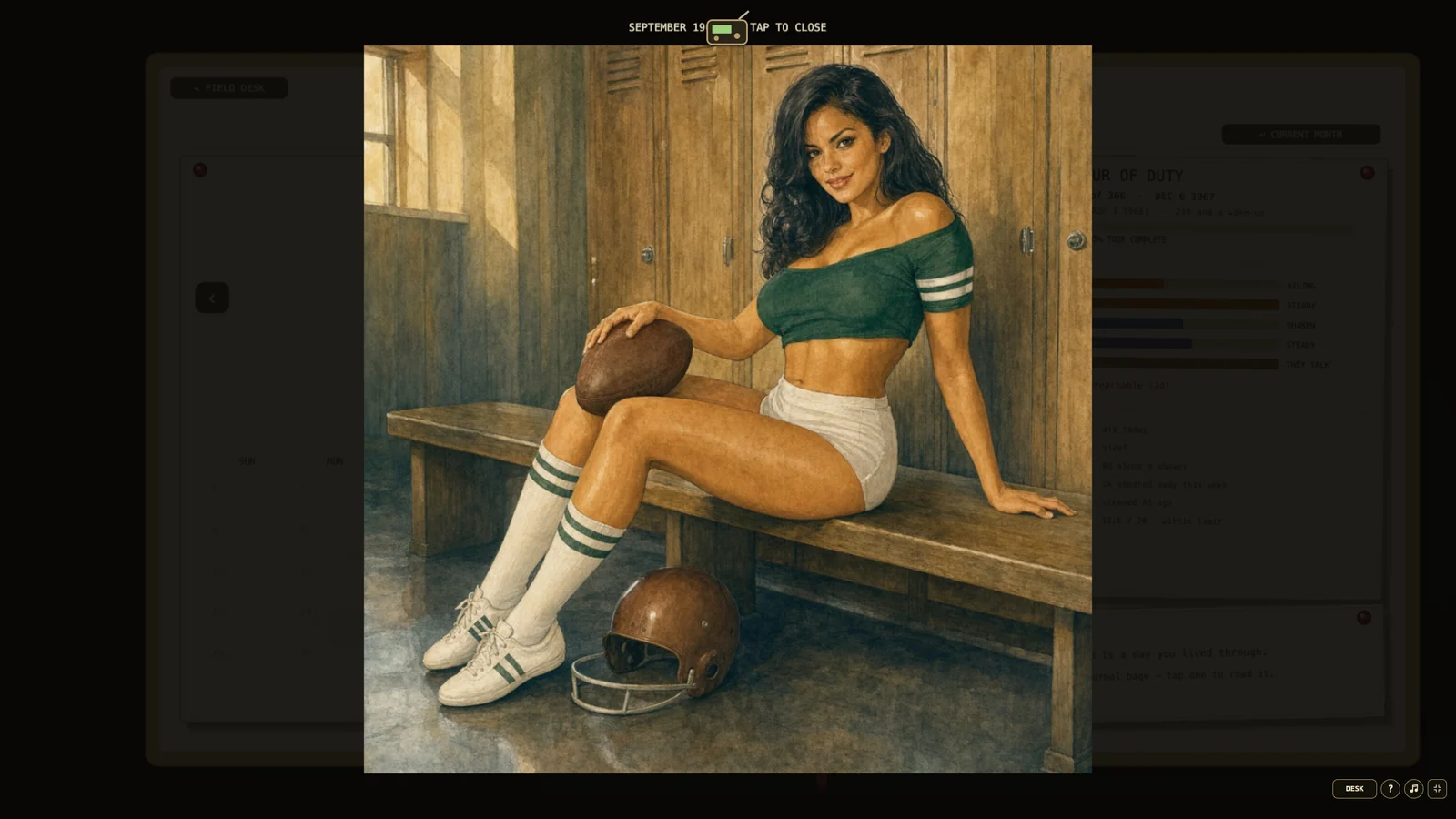
Now it also changes its artwork with the month.
Each month of the tour has an original pin-up image, with additional months extending beyond the campaign's immediate August 1967 to August 1968 span. I have created 72 monthly pieces so far. The current game package contains a complete four-year selection for 1966 through 1969—48 dated plates—with the full tour covered and room on either side of it.
The larger working collection and the runtime selection are kept distinct. Creating more art is not the same thing as placing every piece into the current build.
Why pin-ups belong on this particular calendar
Pin-up calendars were ordinary visual culture in workshops, garages, barracks and military spaces. They mixed glamour, humour, fantasy and the blunt passage of months. For a game about crossing off a year, the format fits naturally.
The images are not presented as historical originals or scans from a known commercial calendar. They are new artwork made for the project is shaped by the period and its culture.
That distinction matters. The goal is not to trick the player into believing a fictional image came from 1967. The goal is to create the kind of personal, slightly escapist calendar surface that could live beside the soldier's dates.
When the player opens a new month, the change is immediate. The grid is still functional. The days still carry their events. But the object has moved forward with the tour instead of behaving like a permanent software panel.
A month should feel different before the player reads the date
Long campaigns create a visual repetition problem. The same menu can be opened hundreds of times. If every return looks identical, time advances numerically while the interface stands still.
Monthly artwork gives the calendar a gentle form of aging and renewal. August does not look like December. January arrives with a different image than the one that watched over the first days in-country. The player may remember a difficult operation by the calendar hanging behind that month, even if the picture itself never enters the story.
The art therefore works as a memory marker. It does not need to award a bonus or unlock a quest. Its value is association.
That is especially useful in a year long campaign. A change that happens every month is infrequent enough to feel noticed and regular enough to divide the year into human-sized sections.
Beyond the thirteen months the first tour needs
The campaign crosses parts of thirteen calendar months, from August 1967 to August 1968. Producing before and beyond that range may look excessive, and in the strict sense it is. But the extra work has practical value for my later goal to expend the game to different year, or have your character reop for a second tour of duty.
It allows the calendar system to be tested outside one narrow date window. It provides neighboring months for menus, previews and historical browsing. It also establishes a broader visual library to work with. That final boundary is important. Extra art creates options. It does not create an obligation to use every option or turn an experiment into public scope.
The current calendar loads the appropriate dated image as the player moves through months, rather than loading the full library at once. The experience remains simple: open the calendar, select the artwork when desired, and close it to return to the dates.
Period atmosphere needs context
Pin-up art also brings a responsibility. A period-appropriate object can still repeat a narrow view of women if it becomes the only visual language the game uses for them.
The calendar images represent one kind of barracks artifact, not the total place of women in the era or the war. Other parts of the project need to carry the wider human record: correspondents, family, Vietnamese civilians, performers, workers, medical personnel, journalists and others whose lives cannot all be reduced to decoration.
That does not require pretending pin-up culture did not exist. It requires placing it honestly and avoiding the claim that one artifact can represent the whole period.
The calendar is still about leaving
The pin-ups bring colour and personality, but they do not change the calendar's central meaning.
Every page still points toward 1 August 1968. Every completed day is one day the soldier cannot live again and one day closer to the Freedom Bird. The monthly picture may be cheerful, playful or quietly strange against that arithmetic.
That contrast is part of the appeal. The calendar offers a small fantasy while remaining the most honest object on the desk. It always knows exactly how much of the tour is left.
Seventy-two pieces of art may sound like a large collection. In play, the idea is much simpler: when the month changes, the wall changes with it. The player notices, perhaps smiles, and then looks back at the number of days to go.