
The Calendar Is Counting With You
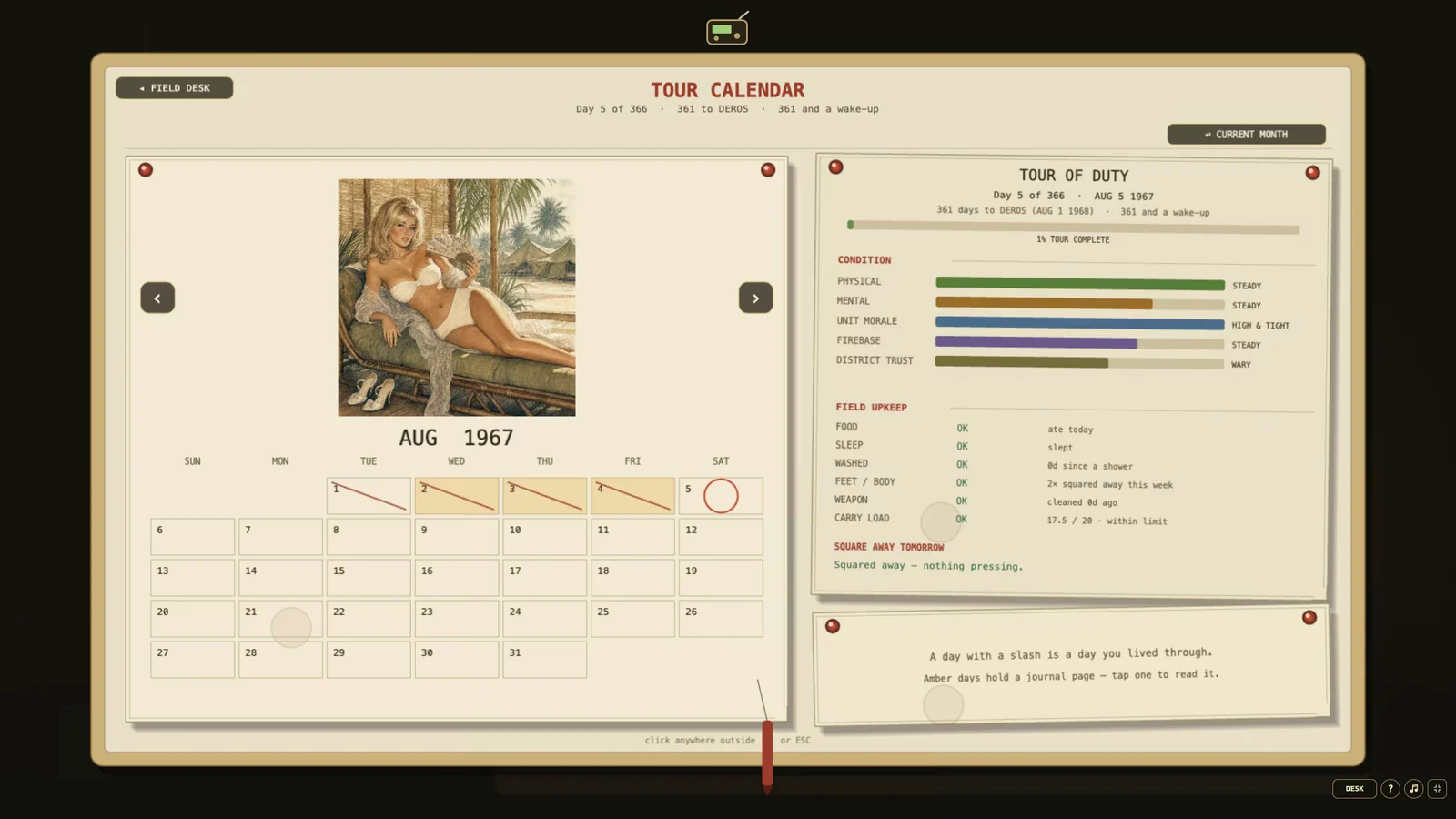
The P.A.T.H.: Vietnam Calendar does more than tell the player the date.
It shows the shape of the tour: 1 August 1967 to 1 August 1968, crossing a leap day on the way. That creates 366 played calendar days, with the final wake-up and Freedom Bird beyond them. The extra February day is not a technical footnote. It is one more day the character has to live.
At first, the Calendar looks like information. Over time, it becomes emotion.
DEROS gives the year an edge
DEROS—the Date Estimated Return from Overseas—places an end on the tour. The character may not control what happens before it, but the date creates a line to move toward.
The Service Record shows the immediate days remaining. The Calendar shows the distance as a field of days, months, duties, and marked events.
Early in the tour, counting can feel useless. The number is too large to hold. The character may speak about home while privately understanding that home is not close.
In the middle, the count becomes a measure of endurance. Seasons, holidays, paydays, mail, operations, and historical events give the abstract number texture.
Near the end, each day can feel heavier rather than lighter. The possibility of leaving makes risk sharper. The character may become cautious, restless, superstitious, generous, withdrawn, or intensely attentive to ordinary life.
The Calendar does not dictate that feeling. It gives the player the conditions to feel it.
What to look for
Open the Calendar when you want more than today's date.
Look at the current position inside the month. Is the player entering a long stretch, approaching a known historical threshold, or moving toward a personal milestone?
Look at condition information. The calendar and Service Record echo the soldier's state so that planning is not separated from time. A tired, strained character approaching demanding days should be read differently from a steady one.
Look at recorded events and completed days. The Calendar becomes a broad index to the tour. It helps the player understand whether a difficult week was an isolated interruption or the beginning of a longer pattern.
Then look at DEROS. Not every time. Just often enough for the number to keep its meaning.
History has dates; life has waiting
A historical game naturally contains famous dates. The danger is allowing those dates to turn every other day into filler.
P.A.T.H.: Vietnam uses the Calendar to resist that. Large history exists on the same page as routine. A payday, a letter's expected transit, an equipment need, a quiet relationship threshold, and a major recorded event all consume the same kind of day.
This is closer to how a life encounters history. People do not stop having feet, debts, birthdays, duties, and private worries because a date will later receive a heading in a book.
The Calendar lets the player anticipate without controlling. Knowing the historical year does not mean knowing the exact fictional result for this character.
Planning without turning the tour into a spreadsheet
The Calendar is useful for preparation, but it should not become a demand to optimize months in advance.
Use three horizons:
Today: check immediate condition, duty, and load.
This week: notice any approaching operation, mail expectation, payday, or personal need.
The tour: keep the DEROS direction and major historical shape in mind.
That is enough. The game's event systems and obligations will interrupt any perfect schedule. Planning should create readiness, not certainty.
The Calendar is also useful for deciding when to train. If experience is banked and the soldier is safely at camp, raising a skill before a demanding stretch may make sense. If condition is poor, recovery may matter more than another improvement.
Time makes every upgrade a choice about when, not only what.
The leap day problem
The tour crosses 29 February 1968. A design that treated the year as a generic 365-day block would either break the historical dates or quietly remove a day.
The current tour keeps the literal calendar. That means 366 played days and the wake-up after them.
This correction may sound small, but it expresses the project's standard. If the game asks the player to care about dates, the dates must be allowed to matter even when they complicate the code or the slogan.
The phrase “365-day tour” still describes the familiar idea of a one-year tour. The playable calendar follows the actual dates.
Short-timer country
As DEROS approaches, the same systems can feel different.
A purchase may seem less worthwhile if it cannot be used for long. A catalogue gift may be racing home beside the character. A relationship may become more urgent because departure is no longer theoretical. A dangerous assignment may feel unfair in a new way. A photograph may become a last one.
The Calendar does not need to add a bright “final act” banner. The shrinking count creates its own transition.
This is one of the project's most important player-side effects. Progress is not represented only by higher skills and rank. It is represented by less time.
One day and a wake-up
Military counting often adds “and a wake-up” because the final morning is different from the days that precede it. P.A.T.H.: Vietnam preserves that feeling.
The Calendar begins as a wall. Then it becomes a road. Near the end, it becomes a door.
Every time you open it, you are looking at the same dates. What changes is the person doing the looking.