Weight Is a Decision
Inventory systems often ask one question: do you own the item?
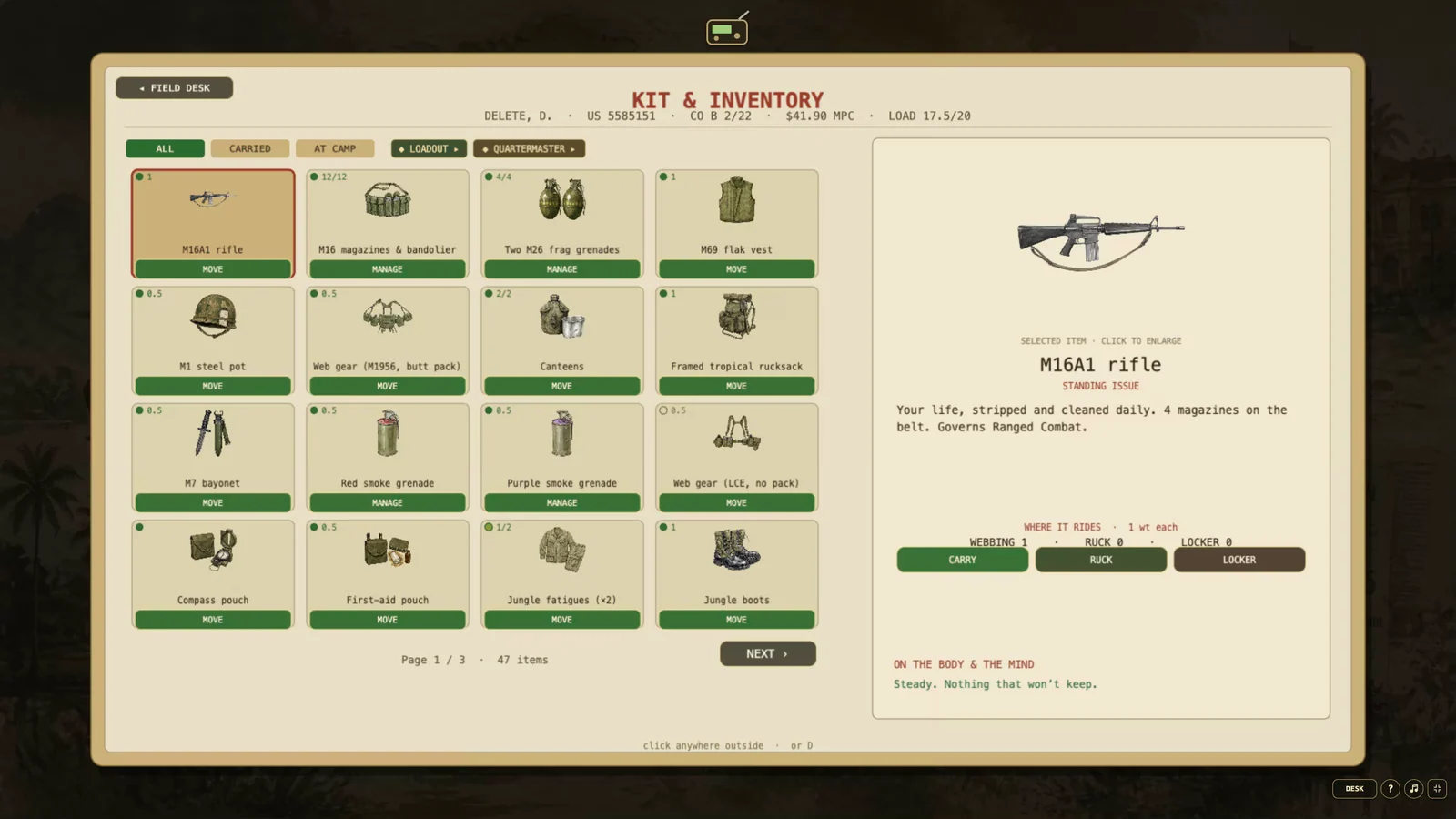
P.A.T.H.: Vietnam asks several more. Where is it? Are you carrying it? Is it in the rucksack or part of the fighting load? Does it help this role? How much does it weigh? What happens to it when you drop the ruck?
These questions turn the Kit & Inventory screen from a collection into a plan. The aim is not to make packing fussy. It is to make equipment physical.
Your limit begins with Strength
The character's free carrying limit is tied to Strength. A stronger soldier can manage more without a penalty. That is useful, but it does not make heavy gear light.
The ALICE rucksack adds substantial capacity. A butt pack adds a smaller amount that remains with the fighting load. Together, they allow a soldier to carry the equipment needed for sustained time away from camp.
Once the carried load passes the limit, penalties begin. A light overage reduces Mobility and Stamina. A heavier overage increases the penalty. A severely overloaded character can be reduced to half speed.
The important point is not the exact bracket. The point is that an item can be useful and still make the whole character less capable.
Weight creates role identity
The system affects every archetype, but it does not affect them in the same way.
The Machine Gunner begins with an obviously demanding weapon and ammunition. The RTO carries a radio and batteries. The Medic carries supplies that feel impossible to leave behind because the missing item may be the one needed. The Engineer and Mechanic carry technical tools. The Forward Observer needs communication and reference gear. Even the Grunt faces the ordinary arithmetic of rifle, ammunition, protective equipment, water, grenades, pack, and personal kit.
Strength can create room, but role creates claims on that room.
This is why loadout is more interesting than a single capacity upgrade. The game is not asking every player to work toward carrying everything. It is asking what this soldier should carry for this job today.
Gear must be on hand to help
P.A.T.H.: Vietnam distinguishes ownership from active use.
A compass in the footlocker does not help Recon in the field. Useful boots do not support movement if they were left at camp. A camera does not create a photograph when it is not carried. A specialty item cannot add its advantage from somewhere else.
This rule makes the footlocker meaningful. It is not a second backpack with no downside. It is a safe place for possessions that matter, but not right now.
Before a movement, review active gear bonuses on the Service Record. If something expected is missing, inspect where the item sits. This quick check can catch a packing mistake without requiring the player to memorize every effect.
The rucksack is a promise you can drop
The ruck solves a problem and creates one.
It adds room for the supplies, spare clothing, comfort, and sustained field needs that do not fit on web gear. While travelling, that capacity matters. When immediate danger arrives, the same pack can slow the character and make movement harder.
The “Drop the Ruck” action allows the soldier to shed the long-movement load and fight on the remaining gear. This reflects a practical distinction: equipment for living through the movement is not identical to equipment for the next few minutes.
Packing well means knowing the difference before contact. Ammunition, medical necessities, communication tools, water, and role-critical equipment should not accidentally disappear with the ruck if the character expects to need them immediately.
The ruck is therefore not just extra capacity. It is a layer of the loadout with its own future decision.
Do not chase the lightest possible number
Once players understand encumbrance, some react by stripping away everything optional. That can create a fast character and a poor tour.
The environment still makes demands. Spare socks, a poncho, food, water, maintenance supplies, batteries, film, and personal comforts can all have value. Perishable items run down over time. A camera carried on the right day can preserve something that cannot be recreated later.
The correct load is not the lightest. It is the load whose purpose you can explain.
Try sorting items into four mental groups:
- Role-critical: the tool without which the soldier cannot do his job.
- Fight-critical: what must remain when the ruck is dropped.
- Sustainment: what keeps the soldier effective across the day or operation.
- Personal: comfort, memory, and identity.
If one group consumes the entire limit, the resulting weakness is part of the choice. A Machine Gunner may need squad help with ammunition. A Medic may carry less personal comfort because the medical kit comes first. A Grunt may accept a small penalty for a longer movement where additional supplies are worth it.
Weight changes over time
A loadout is not a one-time character-creation decision.
Perishables are consumed. New items arrive. Equipment wears. The character may grow stronger in relevant ways or change the work he expects to do. A load that made sense in the dry season may feel different in prolonged rain. A camera matters on a day the player wants to remember and becomes unnecessary weight on another.
Review the kit when the context changes:
- Before a longer operation
- After buying or receiving equipment
- When Mobility or Stamina begins suffering
- When a role-critical bonus disappears
- When the character repeatedly carries something unused
Do not rebuild the pack every shift. Use the system when there is a reason.
The human meaning of the pack
By late tour, kit can become biography.
Some objects are Army issue. Some were bought. Some have been carried so long that removing them feels wrong. A practical player may still keep one item that has no optimal place because it belongs to the character.
That is not a flaw in the system. It is the point where inventory becomes life history.
Weight makes every object ask for justification. Sometimes the answer is survival. Sometimes it is duty. Sometimes it is the small comfort that makes another wet night bearable.
The game gives the player a number. The player decides what is worth it.