
What a Natural Eight Can—and Cannot—Do
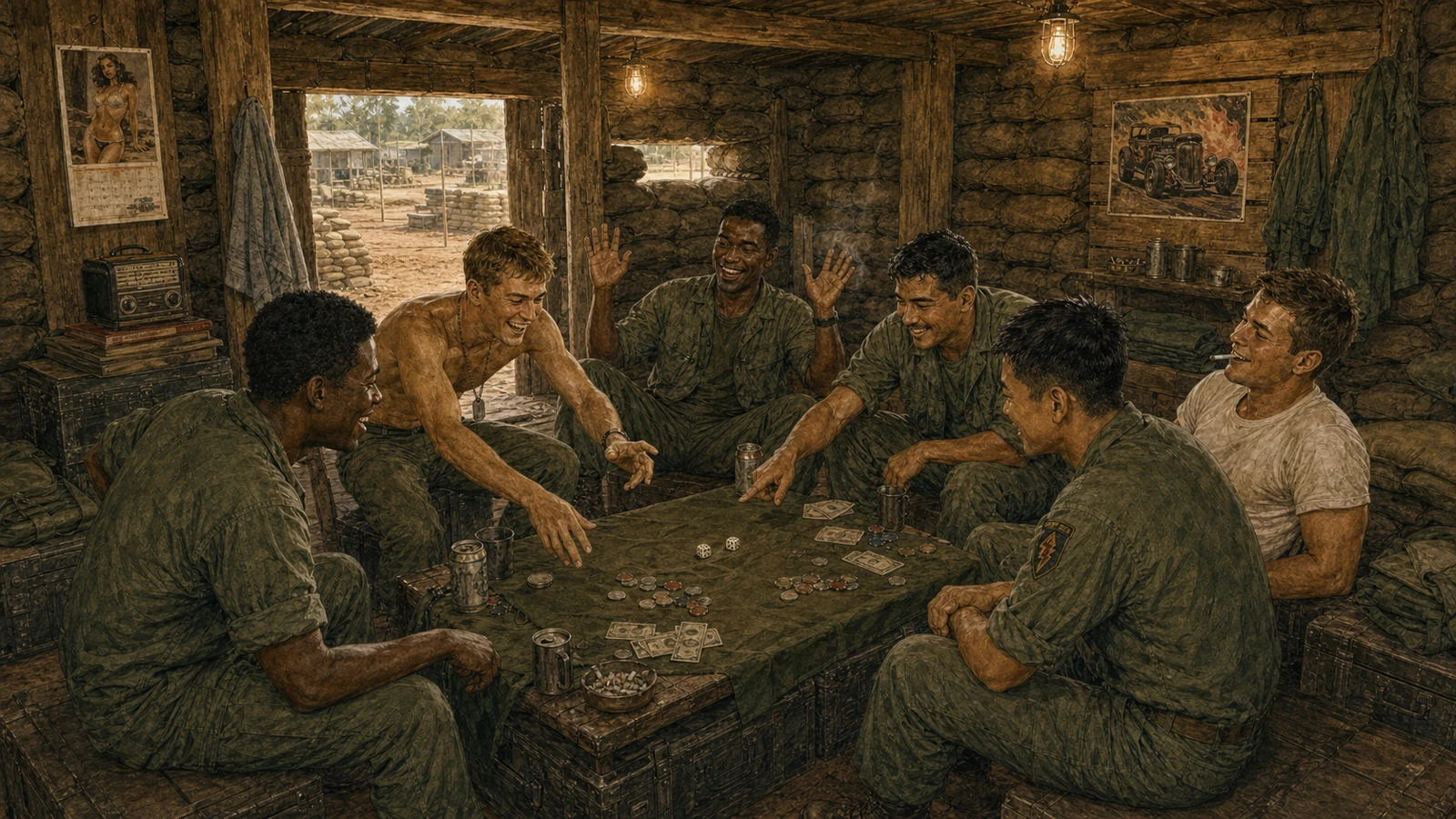
After the work of choosing a method, counting dice and deciding whether the risk is worth taking, I still want the table to enjoy the throw.
There is a reason I called the engine Lucky 8. August gave me a convenient month for the name, and an idea I had been carrying around finally had somewhere to go. But a name is the easy part. I needed an eight to do something you could explain, remember and look forward to rolling.
Building P.A.T.H.: Vietnam (Pivotal Actions Through History) has involved plenty of discarded variations. This is the version I am asking people to read now: every natural eight explodes once, and the Soldier’s own eights can bring a little more than a good total.
First, enjoy the extra roll
Roll the final pool and add every face. Nothing is retained or discarded. Each natural eight scores eight, then you roll that die once more and add the new face.
If the reroll is another eight, add it and stop. One explosion per original die. I want a good moment at the table, not an indefinitely expanding arithmetic assignment.
The rule applies to action dice from the Soldier, Support and Rush. All of them contribute to the total. Compare that total with the Difficulty already stated before the roll.
That last part still matters. The excitement does not replace the question we agreed to answer. It gives the attempt a chance to reach further than the first faces suggested.
An adjusted eight is not a natural eight
Equipment can improve one die when its profile and the method allow it. A scope adding two to a six produces eight in the total. It does not produce a natural eight.
So it does not explode, and it does not count toward a Luck tier. A useful tool improved the action. It did not change what landed on the table.
I am spelling that out because it is an easy place for an example to become slippery. Read the face for Luck. Apply the equipment benefit to the arithmetic. We can enjoy both without pretending they are the same thing.
Keep track of whose dice they are
For the personal Luck tiers, count natural eights only in the acting Soldier’s own capped Stat-and-Proficiency pool after Conditions.
A Support eight still explodes. It helps the total. It does not become the acting Soldier’s private lucky moment. A Rush eight works the same way.
Use different colours or roll the sources separately if that makes it easier. I want this visible enough to avoid a discussion afterward. Somebody else spent an action to help. Someone pushed through danger. The Soldier’s personal dice may also have produced a remarkable break. We can recognise each contribution.
LifeP.A.T.H.—Previous Activities, Training, History—records what the person brings. Support records what somebody else brings. Even in the middle of an exciting roll, I want the game to keep the people in view.
Three tiers, a few concrete benefits
One personal natural eight is Lucky. That die explodes and one small thing goes the Soldier’s way.
Two is On a Roll. Both explode, and two small things or one larger thing go his way.
Three or more is a Lucky Streak. The eights explode, one FUBAR clears, and the Narrator gives him something concrete he did not ask for. Explosion rerolls do not create more Luck tiers.
The interesting word there is concrete. A useful opening. Something about the immediate situation that helps. A detail that belongs in this place with these people, and makes the table lean forward because it matters now.
I do not want a vague promise of future good fortune. I also do not want a catalogue of prizes that turns every eight into a shopping pause. Look at the scene you already have. What plausible thing could go unexpectedly well?
Luck still lives in the same world
The benefit cannot invent training, a Qualification, authority, absent equipment or a person who is not there. It cannot rewrite history or make an impossible method work.
If no aircraft is available, a Lucky Streak does not conjure one. If a Soldier is unqualified for a procedure, an eight does not send him through the course while everybody watches. Those limits were established before the roll and remain afterwards.
That is a useful restriction for me as a designer. It asks for a better benefit than “anything you like.” Something small and specific can be much more satisfying when everybody understands why it matters.
The Soldier catches a break in the situation he is in. He does not acquire control over the rest of the campaign.
A roll worth putting in the journal
Take the Primer’s example of a Soldier reduced to three personal dice. The task is Difficulty 32. He rolls eight, eight, eight.
That initial twenty-four is followed by three explosion rolls: five, four and four. The total is thirty-seven. He succeeds by five, reaching the +4 outcome margin.
The three original personal eights also establish a Lucky Streak. Clear one FUBAR. The Narrator supplies a concrete benefit from the scene. In the example, a second man in the treeline never fires because he is watching what just happened.
Three initial eights on three dice happen once in 512 rolls. I am not building the whole game around expecting that moment. I am making room for it, so that when it happens we know how to enjoy it without throwing away the rules around it.
One point of relief is still one point
A Streak removes one Raw FUBAR under the ordinary limit of four recovery points in twenty-four hours. Current FUBAR cannot drop below the PTSD floor. It does not erase Trauma, remove PTSD or replace the other recovery procedures. It is one stated effect, not a general cure.
I want the good moment to register without flattening everything the Soldier has been through. Sleep, care, time and the other listed forms of relief still have their own requirements. One extraordinary action can matter without solving the person.
That is consistent with what I want from the tour. The record changes. It does not start over every time something goes well.
Where I am with this now
The past two months have involved a lot of writing, trying things, throwing them out and writing them again. I have been working through other systems, probability tables and examples, then coming back to the same question: can somebody actually use this at a table?
The Primer and the player and narrator manuals are much clearer now. The campaign book is taking shape from the setting work I have been carrying forward. I want to talk about that work more openly and hear where the explanation still catches people out.
This rule is a good place to start. Roll everything. Explode each natural eight once. Read the total, then the Soldier’s personal Luck. Let the break belong to the scene.
And when three eights arrive together, take a moment to enjoy them. There will be enough difficult rolls without rushing past a good one.