The Soldier You're Becoming: XP and Advancement
Experience points are easy to understand when they are a bar that fills until a new level appears. P.A.T.H.: Vietnam uses them differently.
There is no single character level. The soldier has twelve skills grouped under Strength, Agility, Intelligence and Empathy. Each skill follows the PATH step-die ladder from D through C and B to A. Improving a skill makes its die larger, but the cost rises at each step.
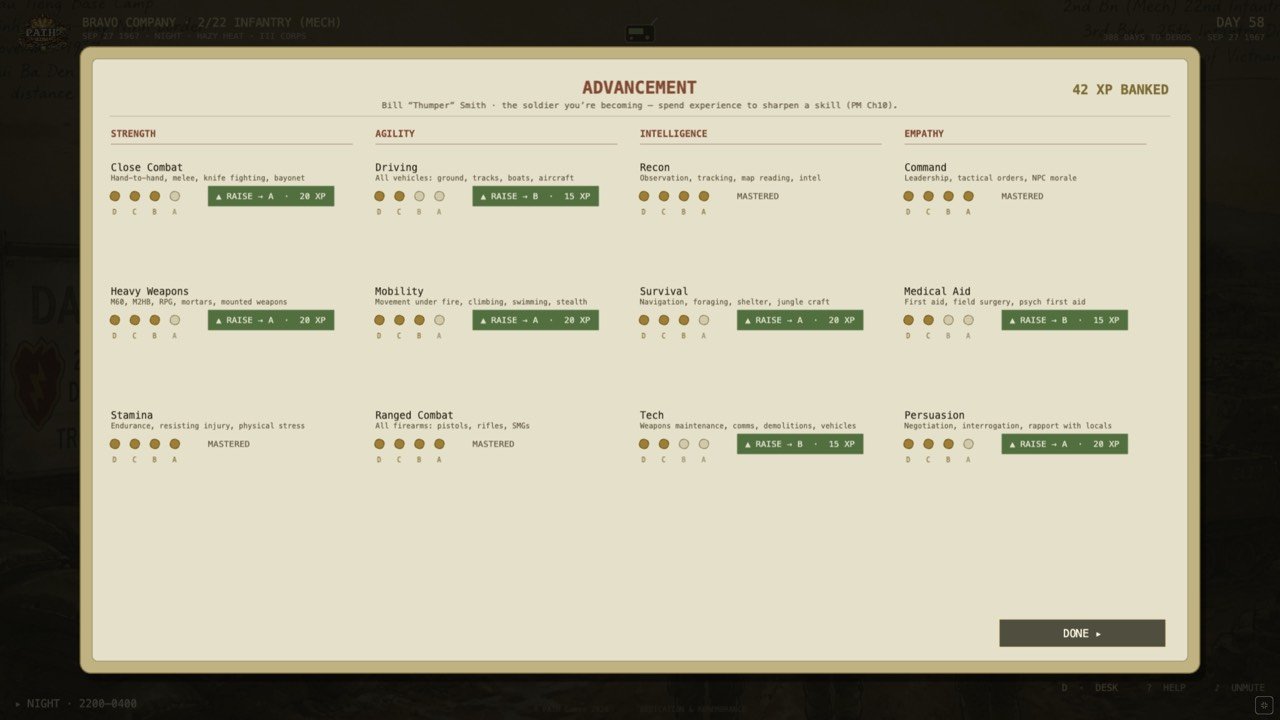
The new Advancement board brings that whole system into one visual page. It shows what the soldier can do now, what the next step costs, how much XP is banked and why a particular skill is available—or still locked.
It is less a level-up screen than a record of what the tour is teaching.
XP comes from doing the job
The digital game once treated each day too much like a tabletop session and paid experience repeatedly. Over a 366-day campaign, that made growth absurdly fast. A soldier could master several abilities early and flatten the difference between being capable, experienced and exceptional.
The current system pays for activity instead.
Work details, perimeter watch, days outside the wire, surviving historical actions, promotions, decorations, recovery, meaningful squad bonds and even the deliberate act of taking a photograph can contribute in different amounts. Field effort matters. Leaning into a difficult job teaches more than coasting through it.
That creates a useful connection between play and advancement. XP is not a daily allowance for opening the game. It reflects what this soldier has actually been doing.
Small acts can add small fractions. Larger responsibilities and dangerous days matter more. Across a long tour, the record grows gradually rather than jumping from one dramatic encounter to the next.
Points are only half the requirement
Banking enough XP does not mean every skill can immediately be raised.
Training also needs a reason. The soldier may have used the skill heavily in the field, found a teacher or reached an opportunity where improvement makes sense. A locked skill explains what would open it instead of showing an unhelpful padlock.
This prevents raw points from buying instant mastery in something the character has never practised. A rifleman cannot simply survive several unrelated days, open a menu and become an expert medic. Growth has to follow experience, instruction or role.
That gate is one of the most important parts of the design. XP measures the capacity to improve. The tour determines what improvement is available.
The Advancement board makes the choice legible
All twelve skills appear together, organized by their governing attribute. Filled pips show the current rating. The next rating and XP cost appear beside it. Affordable and permitted improvements are highlighted. Mastered skills say so plainly.
When the player raises a skill, the banked XP decreases and the new rating is recorded. A short line reflects the kind of growth involved: a motion becoming instinctive, the squad beginning to rely on the soldier, or mastery carrying a cost of its own.
The board is intentionally part of the same paper-and-desk family as the Service Record. Character growth is not an arcade overlay dropped onto the campaign. It is another document on the soldier's desk.
The Service Record shows XP and what a future improvement could cost. Actual training happens during an appropriate moment back at camp. The game may nudge the player when enough XP has accumulated, but it does not force an immediate purchase.
Saving points is allowed. So is strengthening a modest skill instead of chasing the most dramatic one.
Better odds are not the whole character
A larger die improves the chance of success, but it does not erase stress, fatigue, wounds, load, morale or circumstance. The soldier's relationships, decisions and reputation continue to develop outside the skill board.
This matters because advancement systems can quietly turn every story into the same power fantasy. If the only goal is efficiency, every soldier eventually converges on the strongest build.
P.A.T.H.: Vietnam is more interested in divergence. The Medic who becomes a steadier leader, the RTO who improves fieldcraft and the rifleman who learns to read people are different stories even when all three spend the same amount of XP.
A skill can be chosen because it fits the person, the role or the events that have mattered so far.
A practical way to spend XP
When the Advancement board opens, three questions help:
- Which skills has the soldier actually relied on?
- Which available improvement addresses a weakness the player has felt?
- Does the choice fit the person the tour is producing?
The most expensive option is not automatically the best. Raising a frequently used middle skill may change more decisions than polishing an existing strength. Banked XP can also wait for a training opportunity that fits better.
The system is designed to make growth visible without making it automatic. Experience accumulates through work, danger, recovery and connection. Training turns some of that experience into a larger die. The rest remains in the record—the things the soldier did to earn it.
By the end of the tour, the board should tell a story, showing a recognizable person who has become good at certain things for understandable reasons.